Solid aluminium panels are a premium facade material, often seen on landmark commercial buildings. Exterior HPL is a premium choice too, especially for homes and mid-rise buildings. They suit different goals. Here's an honest comparison.
ACP (aluminium composite panels) and HPL are often compared, and we’ve covered that before. Solid aluminium panels are different: single sheets of aluminium, usually 2 to 3 mm thick, with a powder or PVDF coating. They’re strong, non-combustible and can be folded or perforated into dramatic shapes. They’re also among the more expensive facade options.
So how does solid aluminium compare with exterior HPL, and when does each make sense?
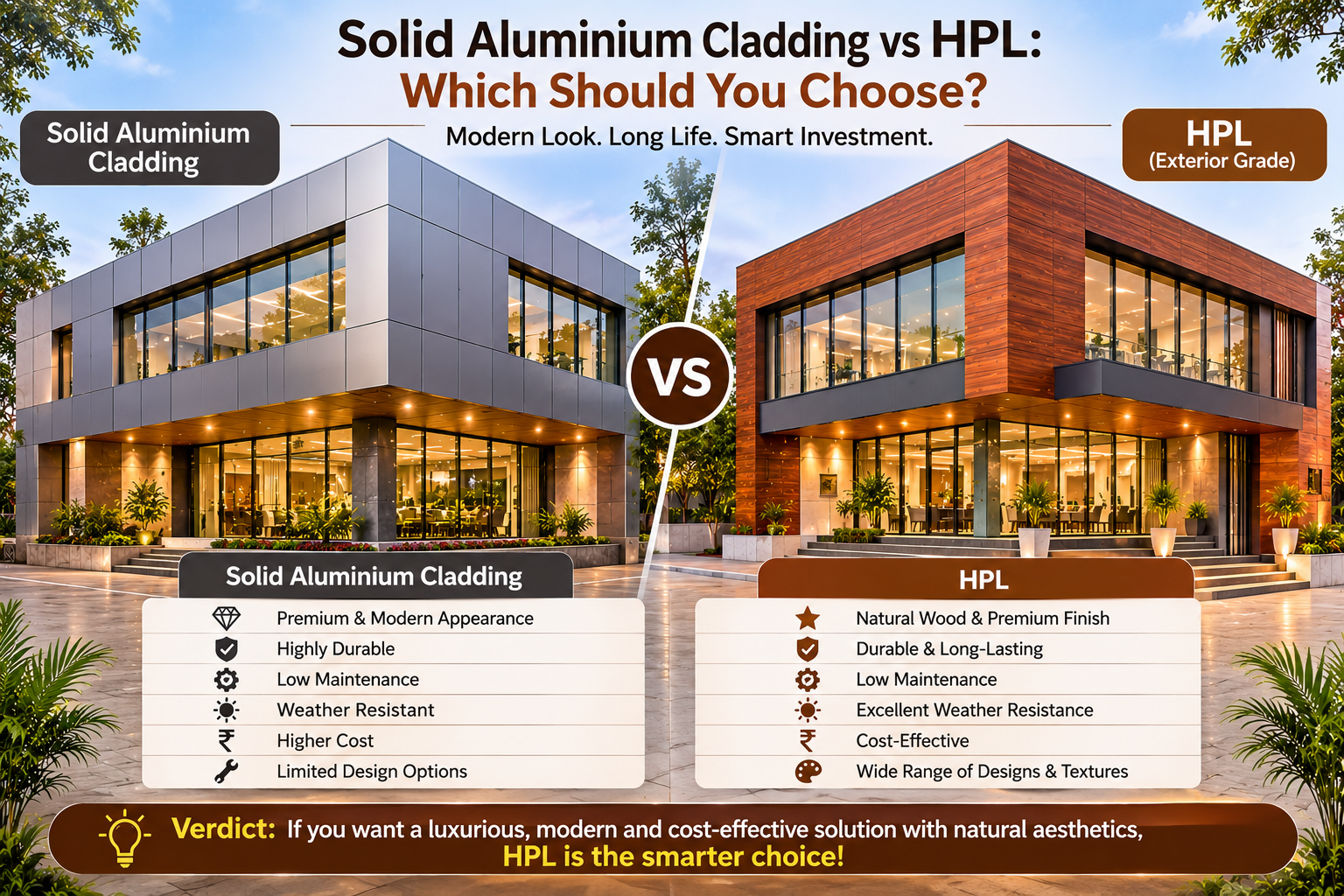
Solid aluminium panels suit high-rise and landmark commercial buildings that need a non-combustible metallic facade or complex folded and perforated shapes. Exterior HPL suits homes, villas, shops and mid-rise buildings that want natural wood, stone or marble-look finishes, impact resistance and lower overall cost. Many projects use both, each where it fits best.
- Solid aluminium is non-combustible, strong and shape-friendly, but costly.
- HPL offers natural-looking finishes metal can’t easily match.
- Aluminium heats up in sun; HPL on a ventilated frame shades the wall.
- HPL handles knocks without denting; thin metal can dent.
- Fire norms for the building may decide the choice on tall projects.
What Each Material Is
Solid aluminium panels: Single aluminium sheets, coated for colour and weather resistance. Can be bent, folded and perforated.
Exterior HPL: Resin-pressed paper layers fused into a dense, solid board with a UV-protected decorative surface. UVCLAD adds a Japan nano coat.
Side-by-Side
| Factor | Solid Aluminium Panels | Exterior HPL |
|---|---|---|
| Look | Metallic, sleek, perforated options | Wood, stone, marble-look, solids |
| Shapes | Easily folded and curved | Flat panels; great for planes and boxes |
| Fire | Non-combustible | Fire-resistant grades; check project norms |
| Heat in sun | Metal heats up | Ventilated frame shades the wall |
| Dents | Can dent on impact | Dense, impact-resistant |
| Relative cost | High | Mid |
| Best for | High-rise, landmark commercial | Homes, villas, shops, mid-rise |
When Solid Aluminium Makes Sense
- High-rise buildings where local codes require non-combustible facade materials.
- Complex shapes: folded fins, curves and perforated screens.
- Corporate metallic branding.
When HPL Makes Sense
- Homes and villas wanting a warm, natural look.
- Shops, showrooms and restaurants needing durable, attractive fronts.
- Mid-rise residential and commercial buildings where HPL meets project requirements.
- Budget-conscious premium projects.
See the Wooden, Stone, Marble and Solid Colours series.
Combination tip: On larger commercial buildings, a common approach is aluminium for complex sculptural elements or upper levels, and HPL for the entrance, podium and areas people see and touch up close.
Decision Steps
- Check fire and building norms for the building’s height and use.
- Decide the look: metallic or natural finishes.
- List shapes needed: flat planes or curves and folds.
- Consider impact zones: ground floors and entrances.
- Compare overall cost including frame and installation.
Mistakes to Avoid
Choosing on looks alone for tall buildings. Fire requirements may decide the material.
Using thin metal at ground level. Dents show quickly in busy areas.
Forcing curves with flat panels. Use the right material for curved designs.
Ignoring heat. Metal facades in direct sun get hot; plan ventilation and insulation.
For more comparisons, see glass facade vs HPL and how exterior HPL performs in Indian weather.
Look and Feel
Solid aluminium panels are usually finished in flat or metallic colours. They suit very industrial or high-tech designs. Exterior HPL offers realistic wood, stone and marble textures as well as solid colours, which makes it a better fit for homes, hospitality and warm commercial designs. If your design calls for natural textures, HPL gives you far more choice.
Dents and Everyday Damage
Metal panels can dent from impacts, such as a ball, a ladder or a vehicle bump, and dents are hard to repair without replacing the panel. HPL is a dense, solid board that resists everyday knocks well, which helps at ground level and in busy areas.
Heat on the Surface
Metal surfaces can get very hot in direct sun. HPL is a resin-and-fibre board and doesn’t conduct heat the way metal does, which matters on walls people touch or walk past.
Installation
Both materials need a proper subframe, correct joints and a ventilated cavity. The installer’s skill matters as much as the material. See exterior HPL installation guide.
Fire Requirements
For tall buildings and public spaces, fire norms decide what can be used. Always confirm the required fire rating with your architect and check the supplier’s documentation for the specific product grade before finalising either material.
Backed by a 15-year warranty. See exactly what UVCLAD covers on your exterior HPL.
Read Warranty GuideFrequently Asked Questions
Is solid aluminium cladding better than HPL?
It depends on the project. Aluminium suits high-rise buildings needing non-combustible facades or complex shapes; HPL suits homes, shops and mid-rise buildings wanting natural finishes and impact resistance.
Does aluminium cladding get hot?
Metal panels heat up in direct sun. HPL on a ventilated frame shades the wall and lets heat escape behind the panels.
Can HPL be curved like aluminium?
HPL is best for flat panels, boxes and fins. Strong curves are better done in materials designed for bending.
Which is more impact-resistant?
Dense exterior HPL handles knocks without denting, while thin metal can dent.
What warranty does UVCLAD HPL have?
UVCLAD exterior HPL comes with a 15-year warranty.
Comparing facade materials?
Talk to the UVCLAD team about where exterior HPL fits your project.
WhatsApp UsExplore UVCLAD HPL