
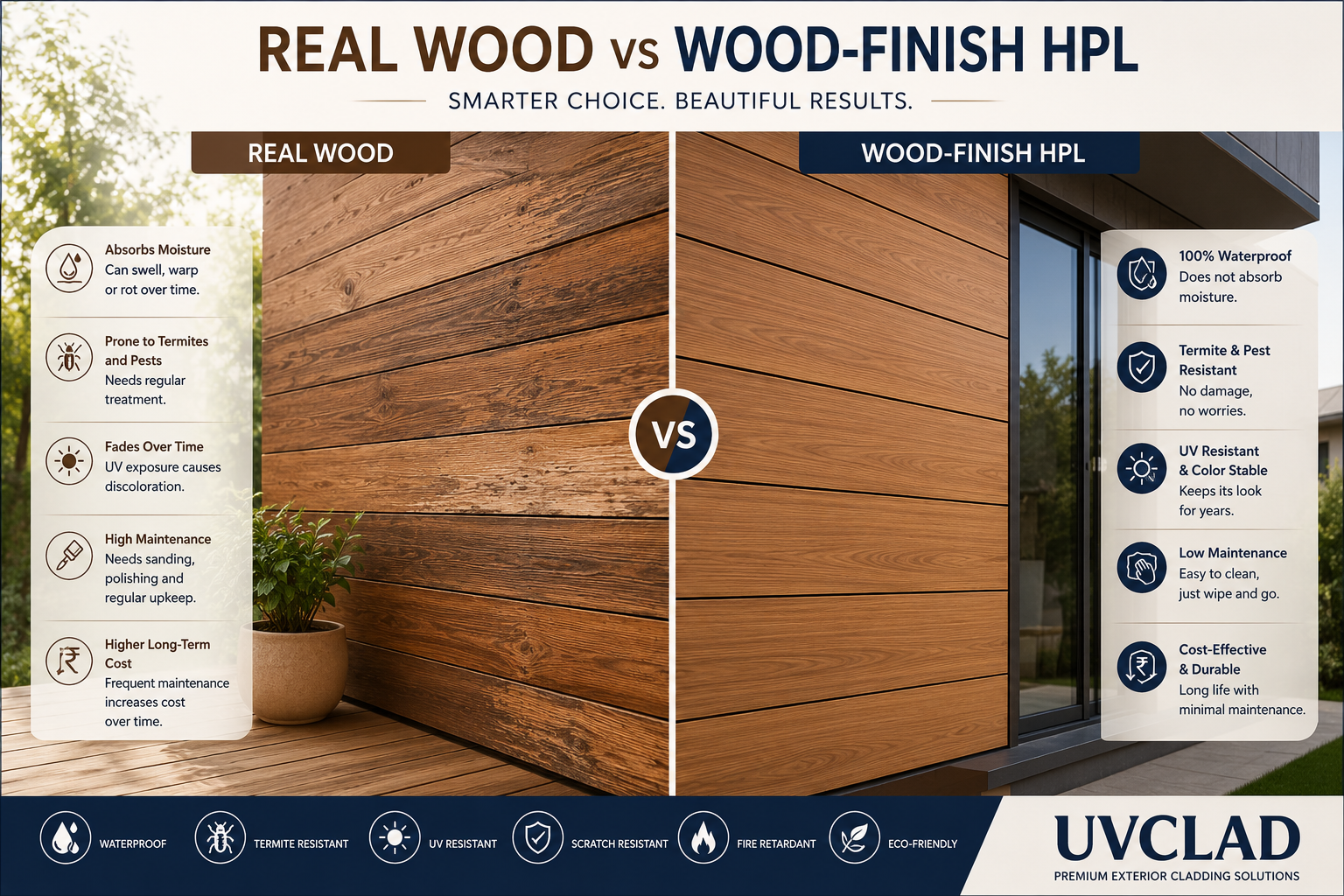
Real wood cladding looks and feels unmatched, but outdoors in India it needs re-polishing every one to two years, moves with humidity and is vulnerable to termites. Wood-finish HPL delivers a very similar appearance with essentially no maintenance. The right choice depends on how much upkeep you are genuinely willing to do.
The Honest Case for Real Wood
Nothing replicates real timber perfectly. It has depth, grain variation that never repeats, and it ages into a patina that many people find more beautiful than when new. It is warm to touch and it smells like wood. If those qualities matter deeply to you, HPL is not the same thing and we would not pretend otherwise.
Real wood also works well in sheltered locations. Under a deep overhang, on a covered porch ceiling, or in a courtyard protected from direct rain, timber performs far better than it does on an exposed facade.
The Reality of Wood on an Exposed Facade in India
- Moisture movement — wood expands and contracts seasonally, opening joints and causing cupping
- UV greying — untreated timber turns silver-grey within months of direct sun exposure
- Re-coating cycle — exterior wood finishes typically need reapplication every 12 to 24 months, including sanding back failed areas
- Termites — a serious risk across most of India; treatment helps but is not permanent
- Fungal staining — high humidity encourages black spotting and mould
- Cost — quality exterior-grade hardwood is expensive, and prices have risen steadily
What Wood-Finish HPL Offers Instead
The decorative layer in HPL is a high-resolution printed paper sealed under a clear overlay. Modern printing has improved substantially, and good wood-finish HPL is convincing from normal viewing distance, particularly with a textured surface that matches the grain pattern.
What you get in exchange for that slight loss of authenticity: no polishing, no termites, no seasonal movement, no greying, and a lifespan of 15 to 25 years with nothing more than periodic washing.
Cost Comparison Over Ten Years
Real wood typically costs more upfront than HPL for comparable exterior-grade timber. Then add re-coating roughly every 18 months, which means material, labour and scaffolding access each time. Over a decade, the maintenance spend on a large wooden facade often exceeds the original material cost.
HPL’s ten-year cost is essentially the installed price plus occasional cleaning.
How to Make HPL Wood Finishes Look Their Best
- Choose textured, not flat. A surface texture that follows the printed grain reads far more naturally than a smooth gloss panel.
- Vary panel widths. Uniform identical strips look manufactured; mixed widths mimic real timber cladding.
- Use shadow gaps. Visible gaps between boards create depth and shadow lines, which is what makes real wood cladding look good.
- Avoid repeating pattern. If the same knot appears every third panel, the illusion breaks. Ask about pattern repeat length.
A Sensible Middle Path
Many projects use real wood in protected locations where it will last, such as an entrance soffit or a covered seating area, and wood-finish HPL on the fully exposed facade. You get authentic timber where people encounter it up close, and low-maintenance performance where the weather is harshest.
Frequently Asked Questions
Does wood-finish HPL look like real wood?
Good textured wood-finish HPL is convincing from normal viewing distance. Up close, someone familiar with timber will notice the difference.
How long does real wood cladding last in India?
With diligent maintenance, 10 to 20 years. Without regular re-coating, exposed timber can deteriorate visibly within 2 to 3 years.
Is wood-finish HPL cheaper than real wood?
Generally yes on material, and substantially cheaper over time once maintenance is included.
Can HPL be used for porch ceilings and soffits?
Yes. Soffits are a common HPL application because they take constant moisture exposure where timber and gypsum struggle.
Explore the UVCLAD Wooden Series for textured wood-grain finishes built for Indian exteriors.