
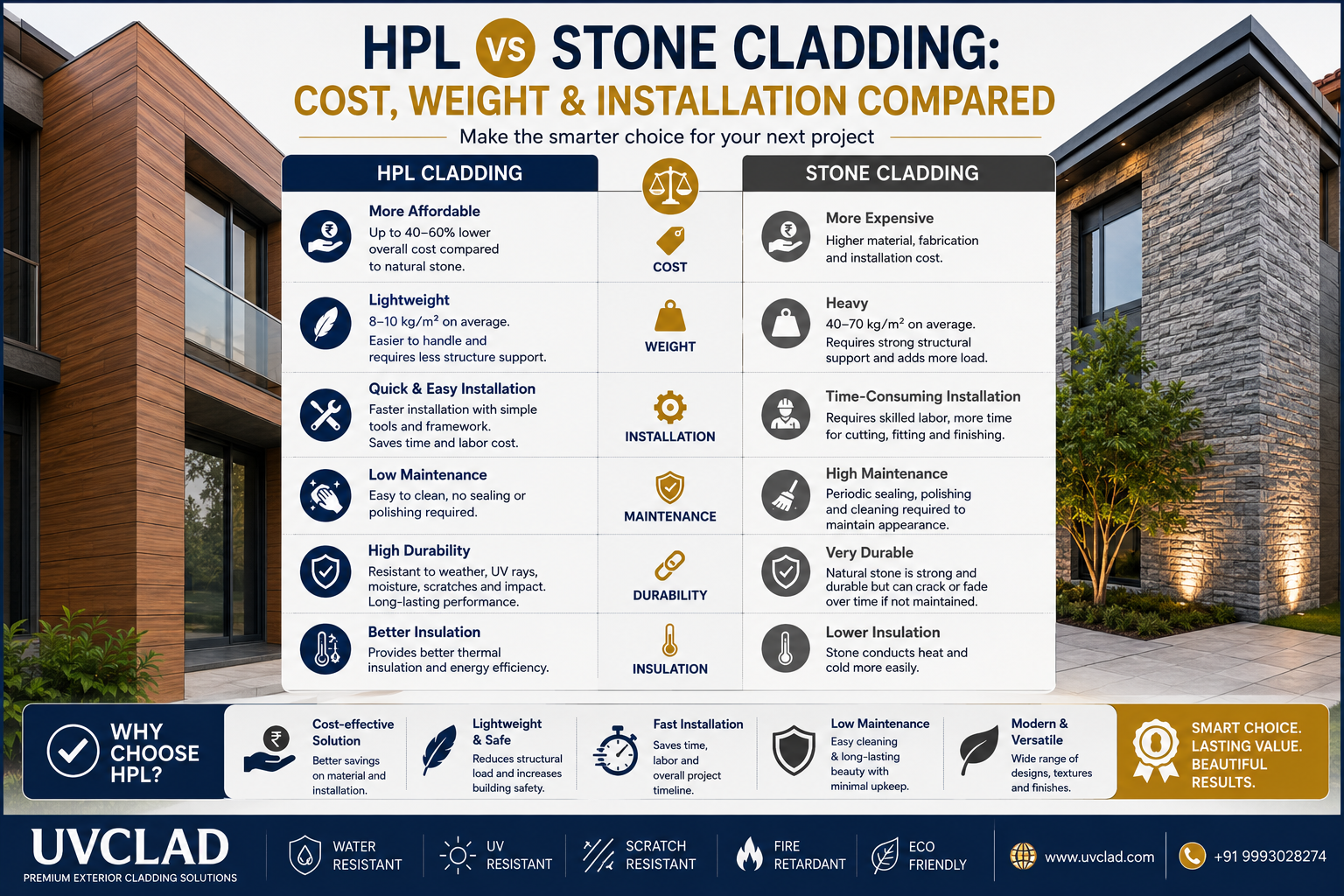
Natural stone cladding weighs roughly ten to twenty times more per square foot than HPL, costs significantly more installed, and takes far longer to fit. Stone-finish HPL gives a comparable visual effect at a fraction of the weight, cost and installation time, though it lacks the genuine depth and variation of real stone.
Weight: The Decisive Practical Difference
Natural stone cladding typically weighs between 25 and 60 kg per square metre depending on stone type and thickness. Exterior HPL at 6mm weighs roughly 8 to 9 kg per square metre.
On a small feature wall this is manageable. On a full elevation, or above ground floor level, stone’s weight has real consequences: the supporting structure must be designed for it, anchoring systems become more complex and expensive, and retrofit onto an existing building may not be structurally viable at all.
Cost Comparison
Natural stone material costs vary enormously by type, from relatively affordable local sandstone to expensive imported marble and granite. But the material price is only part of it. Stone installation requires skilled masons, specialist anchoring hardware, longer site time and heavier lifting equipment.
HPL uses a lighter framework, standard fixing methods and installs considerably faster. On most projects the installed cost gap is wider than the material cost gap suggests.
Installation Time
A stone facade is a slow, skilled trade. Panels are heavy, cutting is dusty and time-consuming, and each piece needs individual anchoring. HPL panels are light enough for two people to handle, cut with standard tools, and fix to a prepared framework quickly.
On a typical villa elevation, HPL installation often takes a fraction of the time stone would require, which also means less scaffolding hire and less site disruption.
Maintenance
Natural stone is porous to varying degrees. Many stones need periodic sealing to resist staining, and untreated stone can develop water marks, efflorescence and biological growth in humid conditions. Repointing may be needed over time.
HPL requires washing with mild detergent. There is no sealing cycle and no pointing.
Appearance: Where Stone Wins
We should be straightforward here. Real stone has genuine three-dimensional texture, natural colour variation across every piece, and a material honesty that a printed finish cannot fully replicate. Up close and in raking light, the difference is visible.
Stone-finish HPL performs best when used at scale on larger elevations, where the eye reads overall texture and tone rather than individual panel detail, and when paired with a surface texture rather than a flat print.
Where Each Makes Sense
Choose natural stone for: ground-floor feature walls where people stand close, boundary walls and plinths, projects where authenticity is the priority and budget and structure allow it, heritage or context-sensitive designs.
Choose stone-finish HPL for: upper-floor elevations, retrofit onto existing buildings, large-area cladding on a controlled budget, projects with tight timelines, or anywhere structural load is a constraint.
Frequently Asked Questions
Is stone-finish HPL as good as real stone?
It performs better on weight, cost, installation speed and maintenance. Real stone wins on authentic texture and natural variation.
How much lighter is HPL than stone cladding?
Substantially. Exterior HPL is roughly 8 to 9 kg per square metre at 6mm, against 25 to 60 kg per square metre for typical natural stone cladding.
Can HPL be installed over an existing stone facade?
Usually yes, using a framework over the existing surface, provided the substrate is sound. This is a common renovation approach.
Does stone-finish HPL fade?
Exterior-grade HPL with proper UV coating resists fading well. Natural stone can also weather and discolour over time.
See the UVCLAD Stone Series for textured stone finishes at a fraction of natural stone’s weight.