
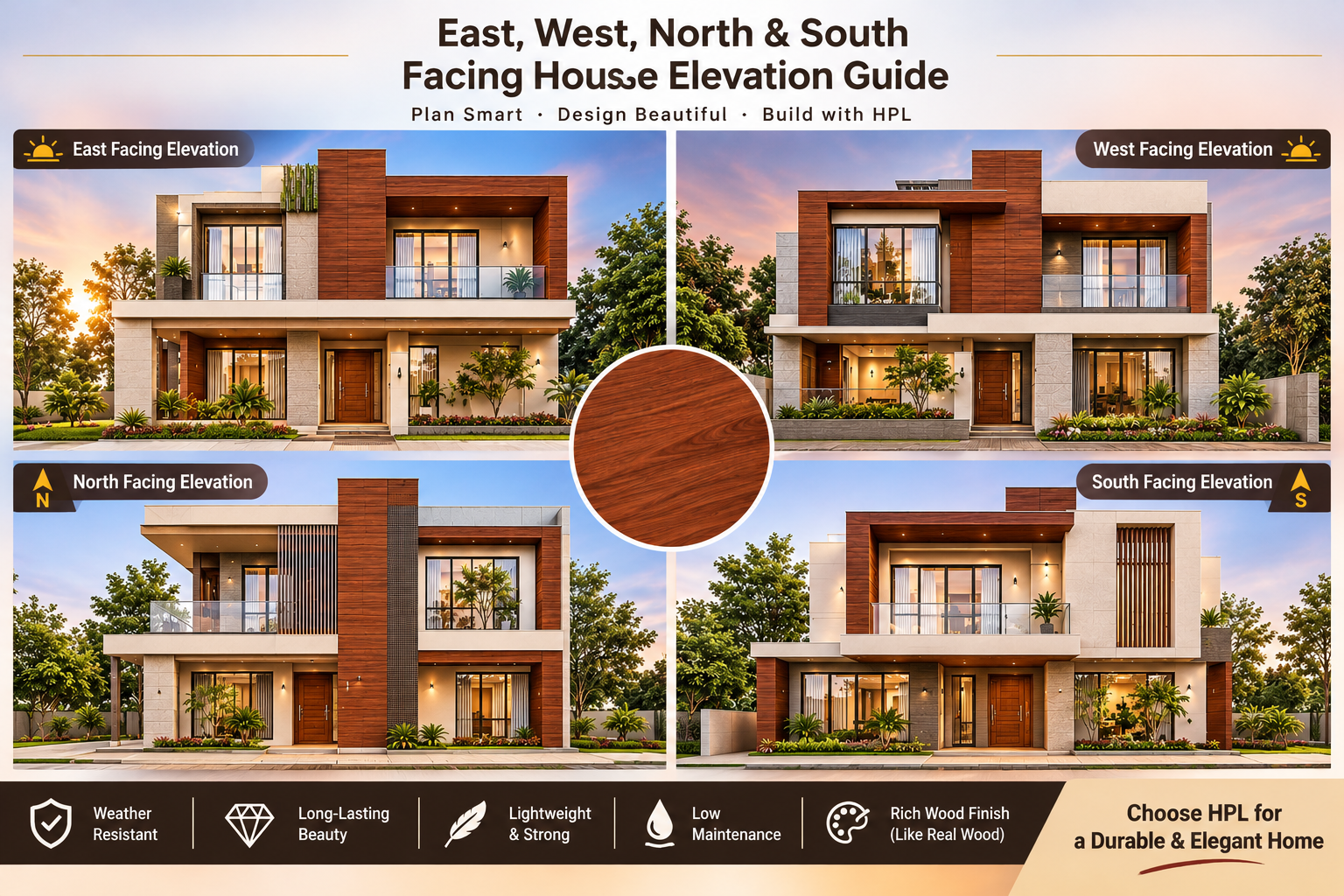
The direction your house faces decides how much sun the front gets, when it gets it and how hard the monsoon hits it. Good elevations work with that, not against it. Here's how to plan for each facing.
Two identical houses can feel completely different depending on which way they face. An east-facing front glows in the morning and stays cooler by afternoon. A west-facing front takes the full blast of the evening sun. North fronts get soft light all day; south fronts get strong sun for much of it.
Your elevation should respond to this. The right finishes, shading and details make a front more comfortable and help it age better.
Plan your elevation around the sun. East-facing fronts suit warm wood tones and lighter shading; west-facing fronts need deep window frames, fins and heat-tolerant mid-tones; north-facing fronts look best in slightly warmer or lighter shades; south-facing fronts benefit from frames that shade glass. Exterior HPL with UV protection handles strong sun on any facing, and UVCLAD backs it with a 15-year warranty.
- Facing changes sun intensity, timing and how colours look.
- West and south fronts need the most shading.
- North fronts get soft light, so avoid dull, dark palettes.
- East fronts are the easiest and suit warm finishes.
- Monsoon direction matters too: check which wall takes driving rain.
East-Facing Houses
Sun: Bright morning sun, shade by afternoon.
What works: Warm wooden finishes glow in morning light. Lighter shading is enough. Balconies are pleasant in the evening.
Tip: Teak and walnut tones look their best here. See the Wooden series.
West-Facing Houses
Sun: Harsh afternoon and evening sun, the hottest exposure.
What works: Deep window frames, vertical fins and recessed balconies to shade glass. Mid-tone finishes that hide heat stress and dust. A ventilated frame behind the cladding helps carry heat away from the wall.
Tip: Read about window surround and fin design.
North-Facing Houses
Sun: Soft, even light; little direct sun on the front.
What works: Slightly warmer or lighter shades so the front doesn’t look dull. Light stone, oak and warm whites work well. Shading needs are low.
Tip: Avoid very dark all-over palettes; use dark tones only as accents.
South-Facing Houses
Sun: Strong sun for much of the day, especially in winter months when it’s lower.
What works: Horizontal projections over windows, box frames and balconies to shade glass. Mid-tone finishes.
Quick Guide by Facing
| Facing | Sun on front | Shading need | Finish suggestions |
|---|---|---|---|
| East | Morning | Low | Warm wood, light stone |
| West | Harsh afternoon | High | Mid-tone wood, charcoal frames, fins |
| North | Soft, even | Very low | Light stone, oak, warm white |
| South | Strong most of the day | Medium to high | Mid-tones, deep frames |
Sample tip: Check samples on the actual wall at the time of day it gets the most sun. A colour chosen in morning light on a west wall can look very different at 5 pm.
Don’t Forget the Monsoon
In much of India, monsoon rain drives in from the south-west, so south and west walls often take the heaviest rain. HPL’s near-zero water absorption protects these walls, but edges and copings must be well sealed. Read how exterior HPL performs in Indian sun, heat and monsoon.
Planning Steps
- Confirm your plot facing with a compass or site plan.
- Note which walls get afternoon sun and driving rain.
- Add shading where sun is strongest: frames, fins, recesses.
- Choose finishes that suit the light on each face.
- Check samples outdoors at peak-sun times.
Mistakes to Avoid
Same design for every facing. A design copied from an east-facing house may overheat on a west plot.
Dark colours on west walls without shading. They absorb more heat and show stress sooner.
Dull palettes on north fronts. Soft light makes dark shades look flat.
Ignoring side walls. On corner and open plots, side walls may face the harshest sun.
For more design ideas, see duplex house front elevation ideas and how to choose exterior HPL colours.
Corner Plots and Two Facings
Many plots face two roads, so you get two facings at once, such as east and south. Treat the main road face as the hero, with the richest finish and the entrance. Then carry one band or accent around the corner so both faces look connected. The sunnier face gets deeper frames and mid-tone finishes. See column and pillar cladding for corner ideas.
Vastu and Design Together
Many families plan entrances and openings by Vastu. HPL works with any layout because the cladding follows the plan rather than dictating it, so you can keep your Vastu choices and still get a modern, durable front.
Backed by a 15-year warranty. See exactly what UVCLAD covers on your exterior HPL.
Read Warranty GuideFrequently Asked Questions
Which facing house is best for elevation design?
Any facing can look great. East-facing fronts are the easiest; west and south fronts need more shading; north fronts need lighter or warmer shades.
How do I reduce heat on a west-facing elevation?
Use deep window frames, vertical fins and recessed balconies, mid-tone finishes, and a ventilated cladding frame that lets heat escape behind the panels.
Which colours suit a north-facing house?
Slightly lighter or warmer shades like light stone, oak and warm whites, with dark tones only as accents.
Does HPL fade on west-facing walls?
UVCLAD exterior HPL has a UV-protective surface and Japan nano coat that help it keep its colour in strong sun.
What warranty does UVCLAD HPL have?
UVCLAD exterior HPL comes with a 15-year warranty.
Planning your elevation by sun direction?
Share your plot facing with the UVCLAD team for finish and shading suggestions.
WhatsApp UsExplore UVCLAD HPL