
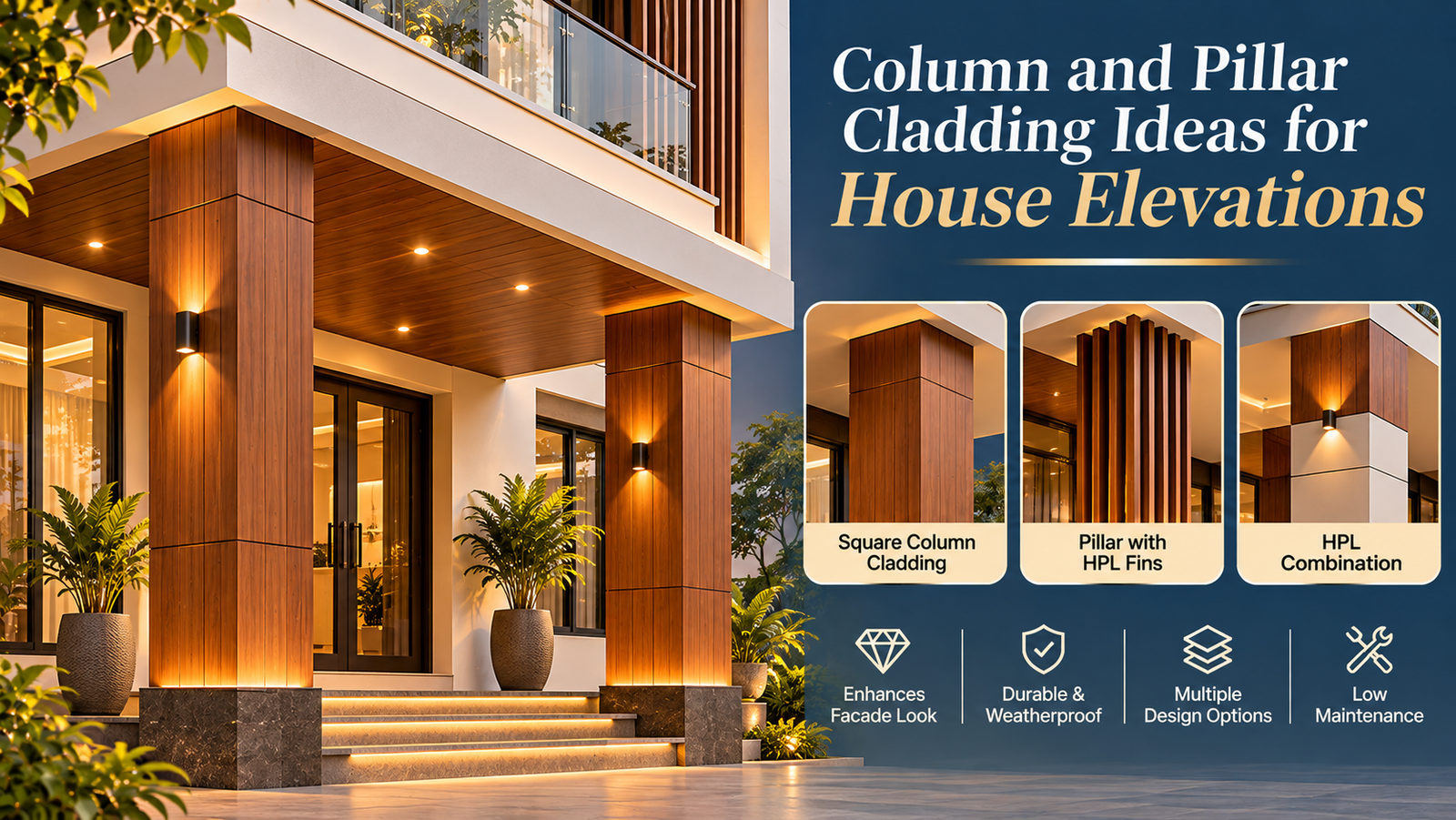
Columns are often the least designed part of an Indian home: bare concrete posts painted to match the wall. With exterior HPL, they become strong vertical features that frame the entrance and lift the whole elevation.
Most Indian homes have columns: at the porch, the car porch, the balcony corners and sometimes running up the full height of the elevation. They’re structurally essential, but visually they’re often an afterthought, plastered and painted the same as everything else.
That’s a missed opportunity. Columns are vertical, repeated and placed right where people look: at the entrance. Clad well, they frame the house like a picture frame.
Column cladding turns plain structural columns into design features. Exterior HPL is well suited because it can wrap square and rectangular columns with crisp edges, comes in stone, wood, marble and solid finishes, resists knocks and water near the ground, and needs very little upkeep. UVCLAD exterior HPL carries a 15-year warranty.
- Columns frame the entrance and draw the eye vertically.
- Stone and marble finishes feel solid; wood feels warm; charcoal feels modern.
- Clean edge trims or mitred corners make clad columns look solid.
- Keep the base slightly above the floor to avoid standing water.
- Match columns to the ceiling, gate or balcony for a unified design.
Where Columns Make the Biggest Impact
Porch columns frame the main door and are seen by every visitor.
Car porch columns are large and highly visible from the street.
Full-height elevation columns run from ground to parapet and give the facade a strong vertical rhythm.
Balcony corner posts define the balcony edges and connect floors visually.
Gate pillars set the tone for the whole frontage. See HPL boundary wall design.
6 Column Design Ideas
1. Stone-finish columns
Light grey or sandstone stone-finish columns look solid and timeless. Pair with a wooden ceiling for warmth. Explore the Stone series.
2. Wooden columns with a white ceiling
Teak or walnut wooden-finish columns feel warm and inviting against white walls.
3. Marble-look porch columns
For a grand, bright entrance, marble-look columns work beautifully. Read about marble-look HPL for exteriors.
4. Charcoal modern columns
Slim charcoal solid-colour columns suit minimal homes and contrast sharply with white walls. See solid colour HPL facades.
5. Two-tone columns
A stone lower half and wooden upper half, split at door height, adds interest to tall columns.
6. Columns with built-in lighting
Linear lights set into a vertical groove on the column face create a striking night-time look. See our facade lighting ideas.
Square vs Round Columns
Exterior HPL is a flat, rigid panel, so it’s best suited to square and rectangular columns, where each face is clad and the corners are finished with trims or mitred joints. Round columns are usually better left in plaster or finished with materials made for curves. If you’re designing a new house, square columns give you the most cladding options.
| Column type | HPL suitability | Finishing method |
|---|---|---|
| Square | Excellent | Four faces with edge trims or mitred corners |
| Rectangular | Excellent | Same as square; ideal for wide porch columns |
| Round | Not recommended | Use plaster or curved materials instead |
Base tip: Keep the bottom edge of column cladding a little above the floor or paving and finish it with a neat skirting trim. This avoids standing water and makes floor mopping easier.
How Column Cladding Is Done
- Measure all faces of each column and note any electrical points.
- Fix a slim frame around the column with anchors.
- Cut panels so joints fall at consistent heights on every column.
- Fix panels and finish corners with trims or mitred edges.
- Add skirting and top trims to close the edges.
- Install lights if planned, with cables run inside the frame.
To estimate material, measure each face’s width × height, add them up, add wastage, and see our guide on how many HPL sheets you need.
Matching Columns With the Rest of the House
Columns look best when they connect to another element: the porch ceiling, the gate pillars or the balcony. For ceilings, read HPL for balcony and porch ceilings.
Mistakes to Avoid with Column Cladding
Inconsistent joint heights. If the horizontal joints sit at different heights on each column, the porch looks messy. Set one joint height for all columns.
Exposed raw edges. Unfinished corners make cladding look applied. Use edge trims or neat mitred corners on every column.
Cladding down to the floor. Water and floor cleaning will sit on the bottom edge. Leave a small gap and finish with a skirting trim.
Forgetting electrical points. Switches, doorbells and light points on columns need to be marked before panels are cut, so openings are neat.
Backed by a 15-year warranty. See exactly what UVCLAD covers on your exterior HPL.
Read Warranty GuideFrequently Asked Questions
Can HPL be used to clad columns?
Yes. Exterior HPL works very well on square and rectangular columns, with each face clad and corners finished with trims or mitred joints.
Can HPL be used on round columns?
HPL is a flat, rigid panel, so it isn’t recommended for round columns. Square or rectangular columns are best for HPL cladding.
Which finish is best for porch columns?
Stone and marble finishes feel solid and grand; wooden finishes feel warm. Choose one that matches your door, ceiling or balcony.
Will clad columns get damaged by knocks?
Exterior HPL is dense and impact-resistant, so it handles everyday knocks well, especially at car porches.
What warranty does UVCLAD HPL have?
UVCLAD exterior HPL comes with a 15-year warranty.
Want your columns to stand out?
Get UVCLAD shade options and a quote for porch, car porch and elevation columns.
WhatsApp UsExplore UVCLAD HPL