It's surprising but true: a weatherproof exterior HPL panel starts as layers of paper. Pressed with resin under intense heat and pressure, those layers become a dense, solid board. Here's the process in simple steps, and why it makes HPL so tough.
When you see an exterior HPL panel on a facade, with its wood grain or stone texture, it’s hard to believe it started as paper. But that’s exactly what HPL, High Pressure Laminate, is: many layers of paper, soaked in resin and fused under heat and pressure into a material that can stand up to years of sun and rain.
Understanding how it’s made helps you understand why good HPL performs the way it does, and why quality varies between products.
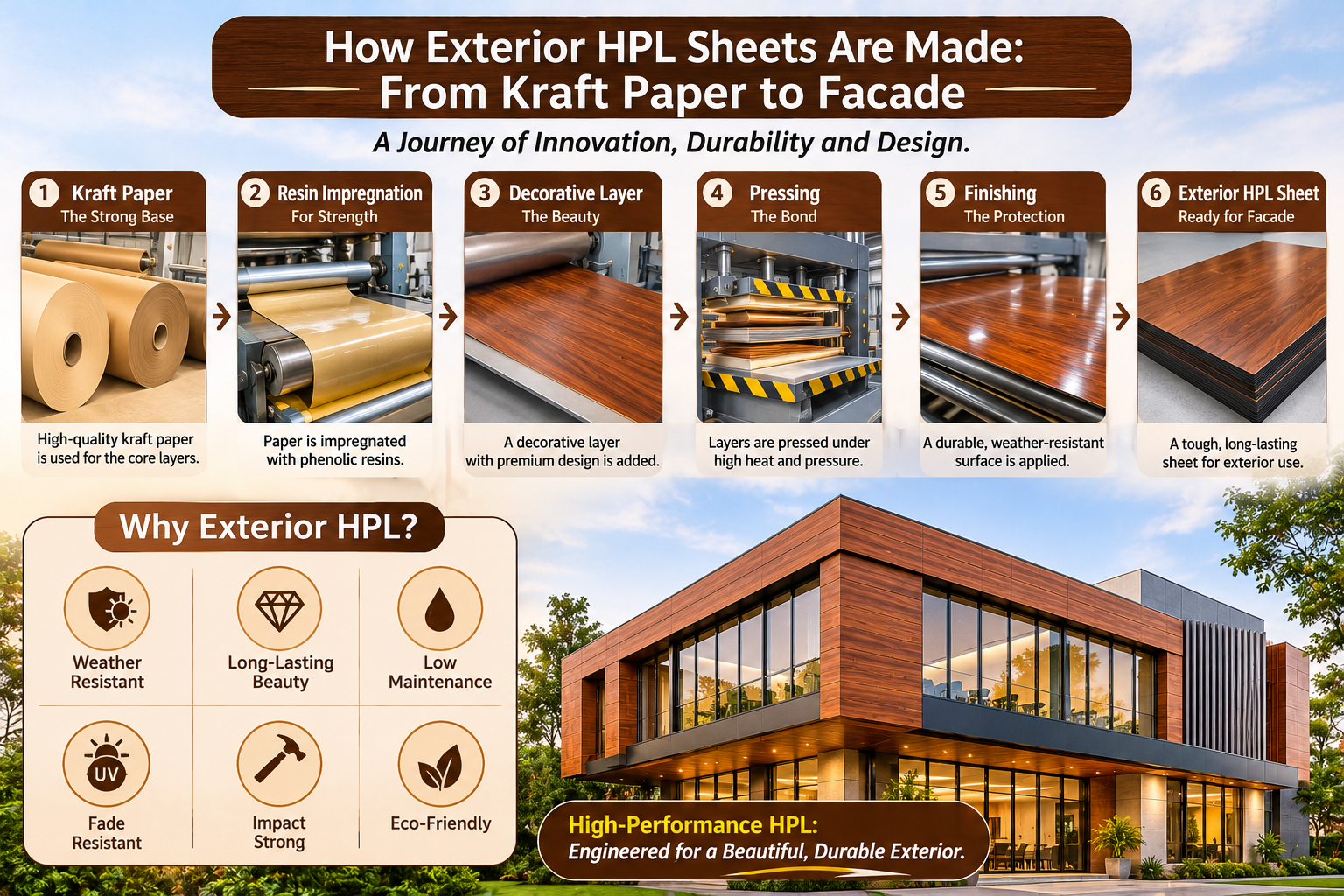
Exterior HPL is made by soaking layers of kraft paper in resin, adding a printed decorative paper and a protective top layer, then pressing the stack under very high pressure and heat. The resin cures and the layers fuse into one dense, solid board. Exterior grades add a UV-protective surface; UVCLAD adds a Japan nano coat for extra surface protection.
- HPL starts as layers of kraft paper and resin.
- A decorative paper on top gives the wood, stone or solid look.
- High pressure and heat fuse the layers into a solid board.
- Exterior grades add UV protection for outdoor use.
- Process quality decides density, stability and colour life.
Step 1: Kraft Paper Core
Strong brown kraft paper forms the core. The number of layers decides the final thickness: a few layers make a thin laminate, many layers make a thick compact board for exterior cladding.
Step 2: Resin Impregnation
The kraft paper is soaked in resin, typically a phenolic resin for the core. The resin fills the fibres and, once cured, makes the board hard and water-resistant.
Step 3: Decorative Layer
A printed decorative paper carries the design: wood grain, stone, marble or solid colour. It’s impregnated with a clear resin, usually melamine-based, that keeps the print sharp.
Step 4: Protective Top Layer
For exterior use, a UV-protective layer is added on top so the decorative print doesn’t fade in sunlight. UVCLAD’s Japan nano coat adds further surface protection.
Step 5: High-Pressure Pressing
The stack goes into a large hydraulic press. Under high pressure and heat, the resins flow, react and cure, fusing everything into a single, dense board. This step is what gives HPL its name and much of its strength.
Step 6: Finishing and Checks
The pressed sheets are cooled, trimmed to size and checked for thickness, flatness, surface quality and colour consistency.
Why the Process Makes HPL Tough
| Property | Where it comes from |
|---|---|
| Near-zero water absorption | Cured resin filling the paper fibres |
| Strength and impact resistance | Many fused layers under high pressure |
| Stability in heat | Thermoset resins that don’t soften like plastic |
| Colour life outdoors | UV-protective top layer |
| Realistic designs | Printed decorative paper |
Quality tip: Look at the cut edge of a sample. Well-made compact HPL has a dense, uniform core with no visible gaps or soft layers. It’s one of the quickest ways to judge quality.
How This Compares With Other Materials
Unlike PVC or WPC, which are plastic-based and can soften with heat, HPL uses thermoset resins that cure permanently and don’t melt. Unlike painted boards, its finish is part of the material, not a coat on top. That’s why HPL holds up so well on facades. See how exterior HPL performs in Indian sun, heat and monsoon.
From Factory to Facade
- Sheets are made and checked at the factory.
- Dealers stock finishes for local projects.
- Installers fix panels to an aluminium sub-frame with an air gap.
- The facade sheds rain, shades the wall and keeps its finish.
See the installation guide for the last step.
Mistakes Buyers Make
Assuming all HPL is the same. Process quality, resin and UV protection vary.
Using interior laminate outdoors. It isn’t made with exterior-grade protection.
Ignoring the core. A weak core can delaminate or warp.
Exterior vs Interior Laminates
Interior decorative laminates and exterior HPL both start with paper and resin, but exterior grades use a denser core, weather-resistant resins and a UV-protective surface. Interior laminates are not designed for sun and rain and will fade or fail outdoors. Always ask for a product made for exterior use.
Questions to Ask Your Supplier
- Is the product an exterior grade with UV protection?
- What thickness is recommended for my application?
- What warranty applies, and what does it cover? UVCLAD exterior HPL has a 15-year warranty.
- Which finishes and series are available, and are samples available?
Backed by a 15-year warranty. See exactly what UVCLAD covers on your exterior HPL.
Read Warranty GuideFrequently Asked Questions
What is HPL made of?
HPL is made of layers of kraft paper soaked in resin, a printed decorative paper and a protective top layer, pressed together under heat and pressure.
Why is it called high pressure laminate?
Because the layers are fused under very high pressure in a hydraulic press, which makes the board dense and strong.
What makes exterior HPL different from interior laminate?
Exterior HPL is thicker and compact, and it has a UV-protective surface designed for sun and rain.
Does HPL melt in heat like plastic?
No. HPL uses thermoset resins that cure permanently, so it doesn’t soften like PVC or WPC.
What warranty does UVCLAD HPL have?
UVCLAD exterior HPL comes with a 15-year warranty.
Want to see the quality up close?
Ask the UVCLAD team for samples and see the dense core for yourself.
WhatsApp UsExplore UVCLAD HPL