
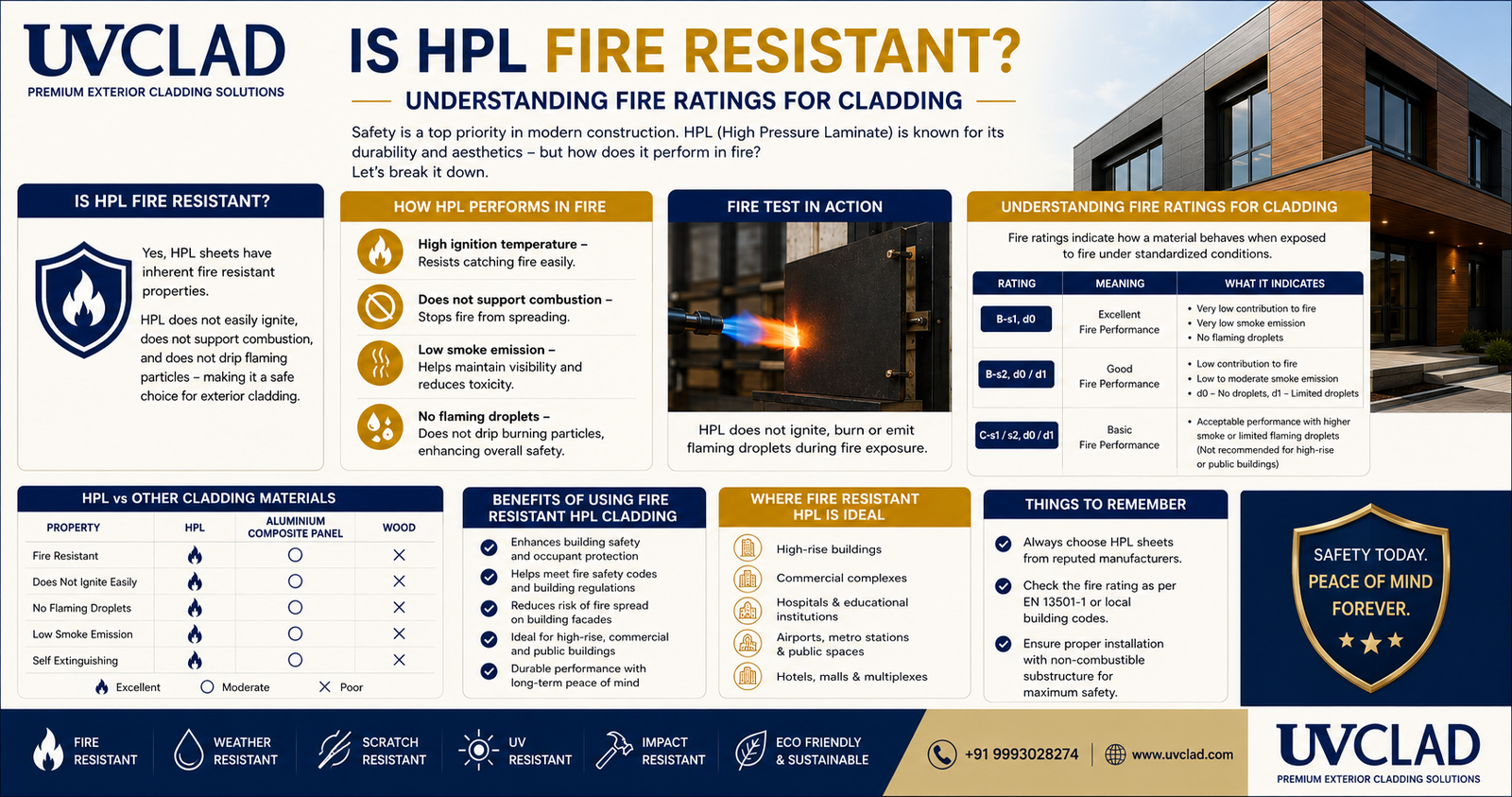
Standard exterior HPL is fire-retardant, meaning it resists ignition and slows flame spread, but it is not fireproof. Fire-retardant (FR) grade HPL adds treated resins that improve this performance further. For commercial, institutional and high-rise buildings, FR grade is usually the required specification.
Fire-Retardant Is Not Fireproof
This distinction matters and is often blurred in marketing. No organic-based cladding material is fireproof. What fire-retardant grades do is resist ignition, burn slowly rather than rapidly, produce less smoke, and avoid contributing significantly to flame spread across a facade. That extra time is what allows evacuation and fire service response.
How HPL Achieves Fire Retardancy
Standard HPL is dense cured resin and paper, which already burns far less readily than untreated wood or a polyethylene core. FR-grade HPL goes further by incorporating fire-retardant additives into the resin system during manufacture. Because these are integral to the panel rather than a surface treatment, they do not wear off or wash away.
Understanding the Classifications
You will encounter several rating systems depending on which standard your project follows:
- EN 13501-1 (European) — classes from A1 (non-combustible) down through B, C, D and E. Facade materials are commonly specified at B-s1,d0 or better, where “s” is smoke production and “d” is flaming droplets.
- ASTM E84 (American) — measures flame spread index and smoke developed index. Class A is the highest rating.
- BIS / IS standards (Indian) — Indian building codes and the National Building Code set requirements that vary by occupancy type and building height.
The important point: ask for the actual certificate and classification, not a general claim that a product is “fire resistant.” Any credible manufacturer will provide the test report.
Where Fire-Retardant Grade Is Usually Required
- High-rise residential and commercial buildings above specified heights
- Hospitals, schools and institutional buildings
- Hotels, malls, cinemas and other assembly occupancies
- Escape routes, stairwell enclosures and corridors
- Any project where the local authority or fire NOC requires it
For a low-rise private residence, standard exterior grade is often acceptable, but check your local requirements rather than assuming.
Why This Became a Serious Issue
Facade fires internationally, most notably in high-rise buildings with polyethylene-core aluminium panels, demonstrated how quickly an inadequate cladding system can spread fire up an entire building exterior. That has driven significantly stricter facade material regulation worldwide, including in India. Specifying cladding purely on price and appearance is no longer defensible on a project of any scale.
The System Matters, Not Just the Panel
A fire-rated panel installed on a poorly designed system does not deliver rated performance. Cavity barriers, fire stops at floor levels, and the framework material all contribute. Discuss the full assembly with your architect or facade consultant, not just the sheet specification.
Frequently Asked Questions
Is HPL fire resistant?
Exterior HPL is fire-retardant, resisting ignition and slowing flame spread. FR-grade HPL offers enhanced performance. Neither is fireproof.
What fire rating does HPL have?
Ratings vary by product and grade. Many FR-grade exterior HPL products achieve B-s1,d0 under EN 13501-1. Always request the specific test certificate.
Do I need fire-retardant HPL for my house?
For a low-rise private home, standard exterior grade is often sufficient. Commercial, institutional and high-rise buildings generally require FR grade. Check local building codes.
Does fire-retardant coating wear off?
No. In FR-grade HPL the retardant is integrated into the resin during manufacture, not applied as a surface layer.
Need fire-rated specifications for your project? Contact us for full technical documentation and test certificates.