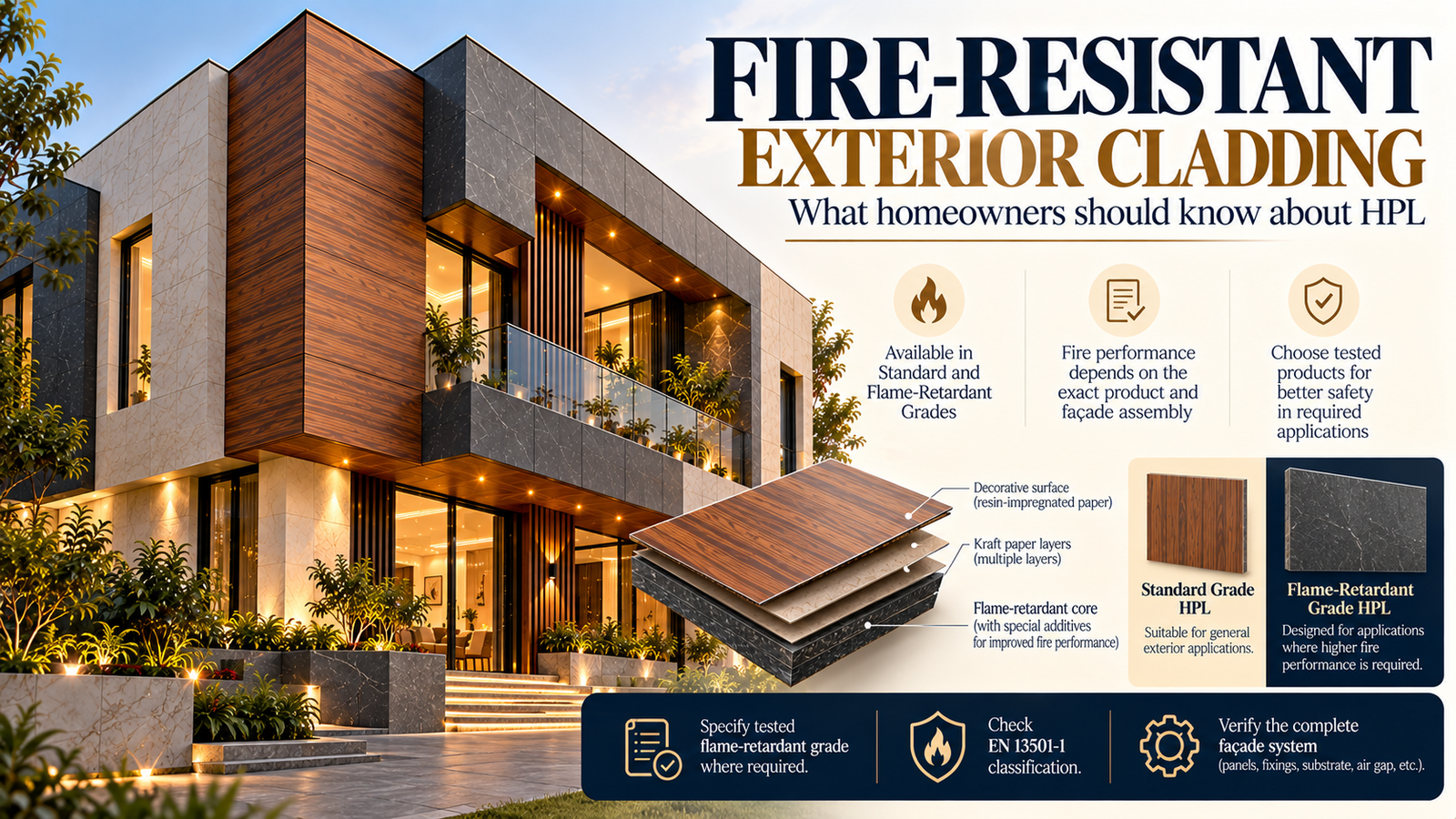
Fire safety isn’t usually the first thing on a homeowner’s mind when picking an exterior finish — colour, texture, and budget tend to come first. It probably should get more attention than it does, especially given how cladding material was directly linked to several major building fires abroad over the last decade, incidents that led to tighter cladding regulations in a number of countries since.
What “fire-resistant” means for a cladding panel
It means the material doesn’t easily ignite, and if it does come into contact with fire, it doesn’t rapidly spread flame across the surface or release large amounts of toxic smoke while burning. It doesn’t mean the panel is literally fireproof under any condition — no cladding material makes that claim honestly.
Exterior-grade HPL is tested against standard fire performance benchmarks as part of manufacturing, not as an optional add-on. That’s a meaningful difference from ACP, where the fire-retardant, mineral-core version is a distinct (and pricier) product line from the standard combustible-core version, and a buyer has to specifically know to ask for it.
Why this matters more on multi-storey buildings
On an independent single-storey home, a cladding fire risk is serious but contained. On an apartment building, a hotel, or anything with multiple floors, cladding that catches and spreads fire quickly turns a localised incident into something that can travel up an entire facade in minutes — which is precisely the failure mode behind the international incidents that changed fire codes. This is part of why architects specifying facades for taller or commercial buildings increasingly ask for fire test documentation upfront rather than taking a supplier’s word for it.
What a fire test certificate should actually show
A legitimate fire performance certificate names the specific test standard used, the panel thickness and grade tested, and the classification achieved — not just a general statement that the product is “fire safe.” If a supplier can’t produce this document when asked, that’s worth treating as a red flag, not an oversight.
The practical test, at home
You don’t need a lab to get a rough sense of behaviour. A small offcut held briefly to a flame source should self-extinguish once the flame source is removed, rather than continuing to burn and spread on its own. This isn’t a substitute for a proper certified test, but it’s a reasonable sanity check before committing to a full facade.
FAQ
Does fire-resistant HPL cost significantly more than standard exterior HPL?
No — for UVCLAD, exterior-grade fire performance is built into the standard product, not a separate premium tier.
Is fire-resistant cladding required by law for residential homes in India?
Requirements vary by state and building height, and are typically stricter for buildings above a certain number of floors. It’s worth checking local building bylaws, but even where it isn’t mandatory, it’s a reasonable thing to prioritise anyway.
Can existing ACP cladding be checked to see which grade it is?
A cut cross-section shows the core material and can be sent for basic testing, but the safest route is asking the original supplier for the certificate rather than assuming.
Ask for the fire test certificate directly — a supplier confident in their product will have it ready, not promised “later.”