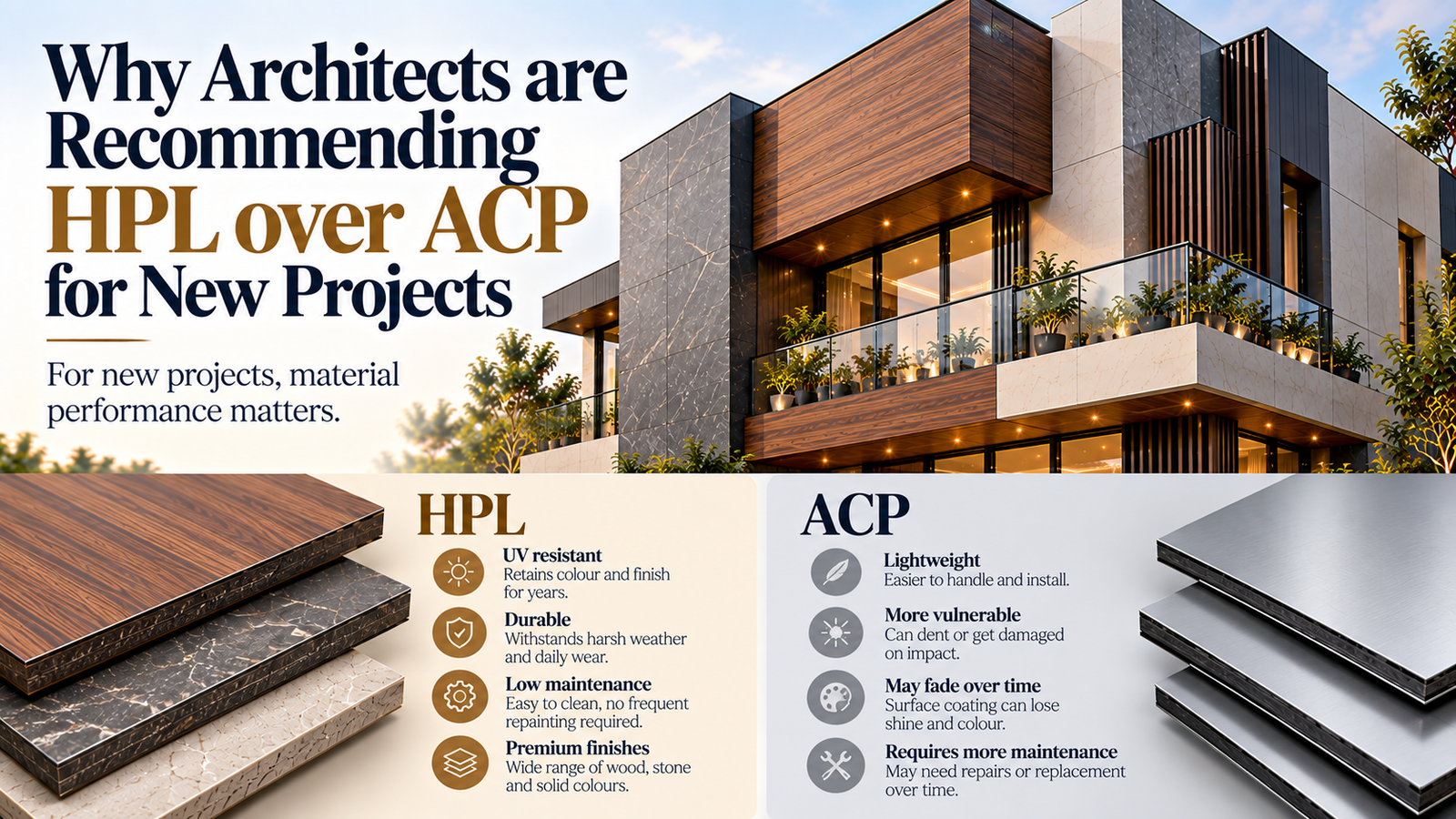
Stand in front of a newly clad building and you often can’t tell whether it’s HPL or ACP. Both come in wood, stone and solid finishes. Both look sharp on installation day. The difference shows up later, and it comes down to what each material actually is underneath the surface.
What ACP is, structurally
ACP — aluminium composite panel — is two thin aluminium sheets sandwiching a plastic (usually polyethylene) core. It’s light, easy to cut, and has been the default choice for commercial signage and facades for years, partly because it’s cheap and fast to fabricate.
The catch is in that word “thin.” The aluminium skins are typically under half a millimetre each. That’s enough for a flat, rigid panel, but not much protection if something presses against it.
What HPL is, structurally
HPL — high pressure laminate — is solid through its thickness. Layers of kraft paper are impregnated with resin and compressed under heat and pressure into a dense, uniform panel, with a decorative and protective top layer. There’s no thin metal skin to dent, and no plastic core to worry about in a fire.
Denting is the everyday difference
This is the one homeowners notice first in real life. A cricket ball, a ladder leaned carelessly, a delivery cart bumping the wall — an ACP panel dents visibly, because that thin aluminium skin deforms easily. HPL, being solid and dense through its thickness, resists that kind of everyday impact far better. You won’t find dented HPL panels the way you find dented ACP shopfronts.
Fire performance is the difference that matters more
This is the one that should matter more than it usually gets discussed. Standard ACP has a polyethylene (PE) core, which is combustible — this material has been directly implicated in several serious building fires internationally over the past decade, which is why many cities have since tightened fire-safety codes around ACP use on tall buildings. Fire-retardant ACP variants exist, at a higher cost, with a mineral-filled core that behaves better.
HPL doesn’t have that core-material problem to begin with. Exterior-grade HPL panels are tested and rated for fire performance as a standard part of the product, not an upgrade you have to specifically ask for and pay more on.
Cost is where ACP still wins upfront
Being honest about this: ACP is usually cheaper per square foot than HPL, sometimes by a meaningful margin. If budget is the only constraint and the application is low-risk — a small signage board, an interior feature wall — that upfront saving might make sense. For a home’s main exterior facade, where you’re weighing 15 years of weather exposure and the fire question, the calculation looks different.
FAQ
Is all ACP unsafe to use?
No — fire-retardant (FR) grade ACP with a mineral core performs much better than standard PE-core ACP. The issue is that standard PE-core panels are still widely sold because they’re cheaper, and buyers aren’t always told which grade they’re getting.
Can you tell HPL and ACP apart just by looking at the panel edge?
Yes. Cut a small sample and look at the cross-section — ACP shows two thin metal skins with a visible gap of core material between them. HPL shows a solid, uniform, layered material all the way through.
Does HPL cost more to install, not just to buy?
Installation labour is broadly similar for both, since the fixing systems are comparable. The price difference is mostly in the panel material itself.
Compare actual samples side by side before deciding — cut a piece of each, try to dent it, and the difference stops being theoretical.