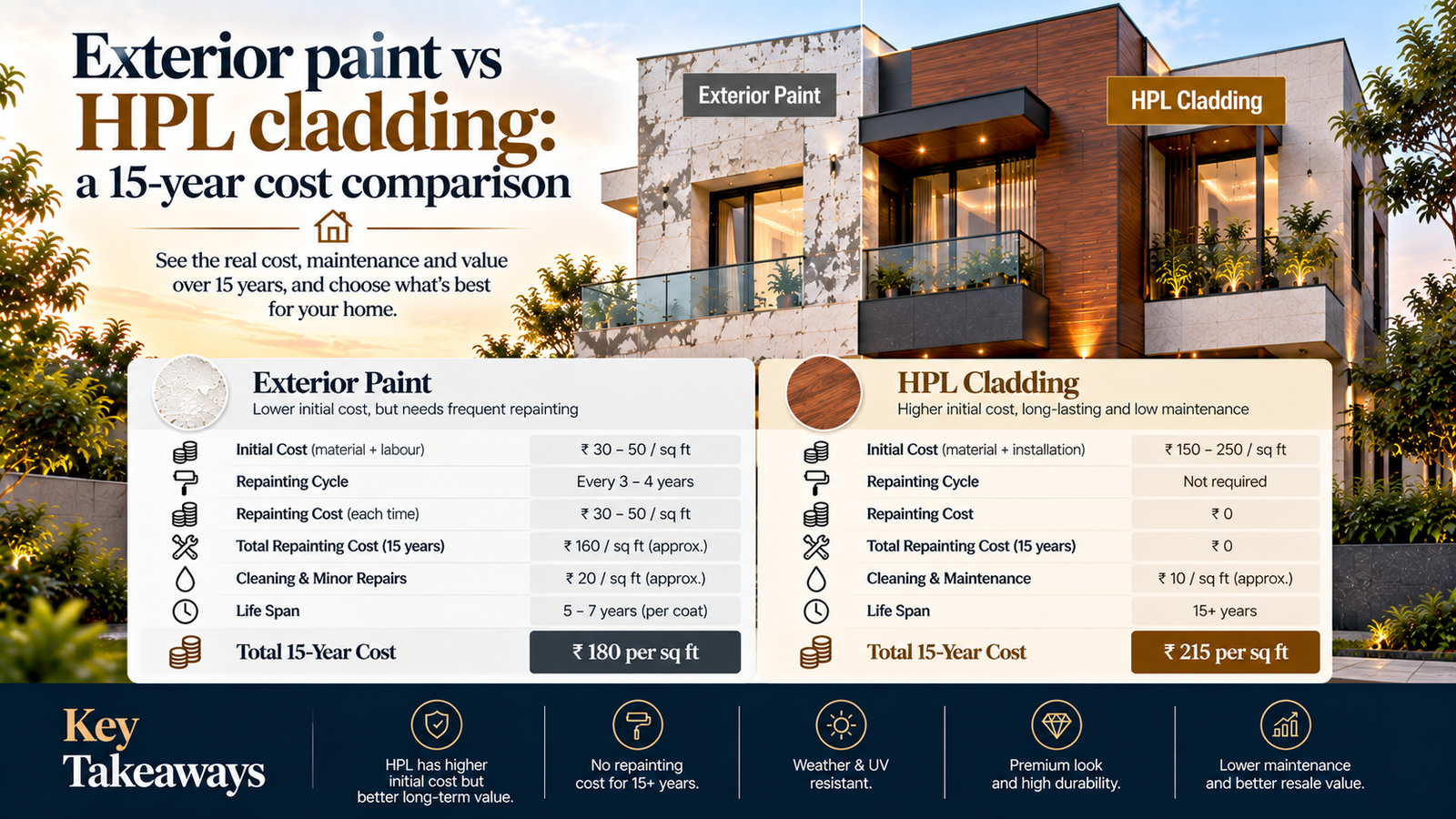
Textured paint costs a fraction of cladding upfront and delivers a genuinely good-looking elevation for the first few years. Cladding costs considerably more and holds its appearance for fifteen to twenty-five. Which is right depends on how long you intend to keep the house looking the way it does on day one.
What Textured Paint Does Well
Being fair to it first, because it is often dismissed unfairly.
Textured exterior paint is applied directly to plaster, needs no framework, adds no thickness, and works on curved and irregular surfaces that panels cannot follow. It can be mixed to any colour, including matching something you have seen elsewhere. It is quick to apply, and a skilled applicator can produce effects — sand finish, stone effect, patterned rollers — that look sophisticated.
On a small single-storey house with easy ladder access, repainting is cheap enough that the long-term argument for cladding weakens considerably.
Where It Struggles
The repaint cycle
Exterior paint in Indian conditions typically needs redoing every three to four years, sooner in coastal, high-rainfall or high-pollution areas. Each cycle is not just paint — it is surface preparation, scaffolding, labour and disruption.
The declining years
This is the part that is easy to overlook. A painted facade looks excellent for about a year, fine for two, and visibly tired for one more before the next repaint. Averaged across a decade, it spends a meaningful share of its life looking past its best.
Texture holds dirt
The rougher the texture, the more it catches dust and the harder it is to wash. Deep textured finishes in dusty cities grey off noticeably within a couple of years.
It shows what is behind it
Paint follows the wall. Cracks, patch repairs, uneven plaster and damp marks all telegraph through, sometimes within months. Cladding spans over all of it.
Where Cladding Wins
- Consistency over time — year eight looks close to year one, with no cycle of decline and reset
- No scaffolding cycles — a single installation rather than repeated access
- Realistic wood and stone finishes — paint cannot match a genuine wood-grain panel at close range
- Covers existing problems — useful on older houses with cosmetic wall damage
- Washes clean — a smooth or lightly textured panel wipes down in a way rough paint does not
The Honest Decision Framework
Ask yourself three questions.
How long will you own this house? If you expect to sell within three or four years, textured paint is the sensible spend. The cladding argument is a long-hold argument.
How tall is the facade? Single storey with ladder access makes repainting cheap. Three storeys requiring scaffolding each time changes the arithmetic sharply.
What look do you actually want? If you want a wood or stone appearance, paint will not get you there and the comparison is moot. If you want a clean painted colour, paint does that perfectly well.
The Combination Most People Overlook
You do not have to pick one. Clad the entrance volume, the staircase tower or the feature wall — the parts people actually look at — and paint the rest.
This is how most well-judged Indian elevations are actually built, and it puts the budget where it is visible rather than spreading it thin. UVCLAD panels are often bought this way rather than for whole facades.
Frequently Asked Questions
How often does exterior textured paint need redoing?
Typically every three to four years in Indian conditions, sooner in coastal or high-pollution areas.
Is cladding worth it over paint?
On taller facades, long-held houses and where a wood or stone look is wanted, generally yes. On a small single-storey house you plan to sell soon, paint is the sensible spend.
Can I clad over an existing painted wall?
Yes. Cladding fixes to a framework over the existing surface, so paint condition underneath does not matter cosmetically.
Does textured paint hide wall cracks?
Only briefly. Cracks and patch repairs usually telegraph through within months.
Weighing both options? Send us your elevation photo and we will tell you honestly which makes more sense for your house.