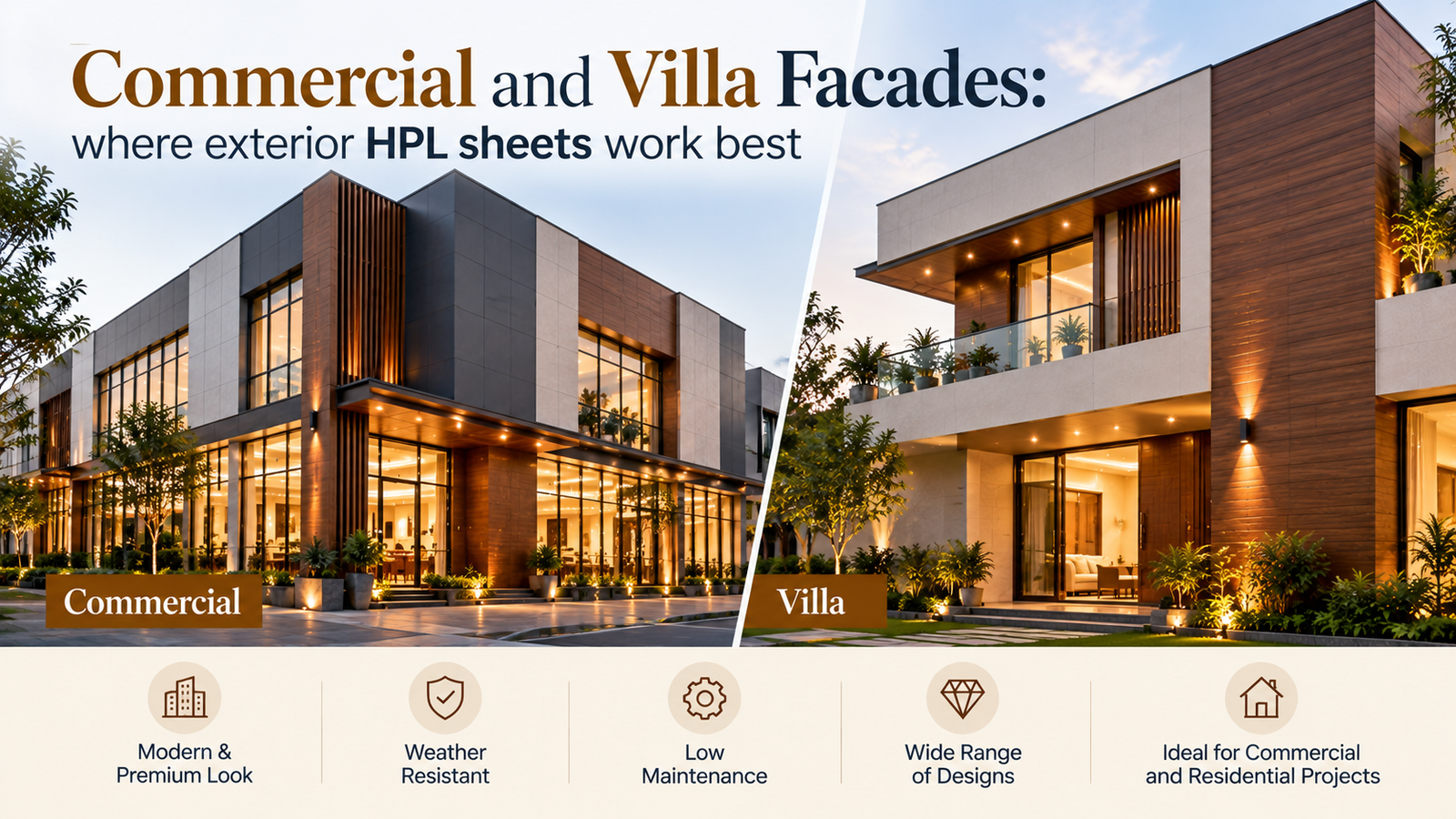
HPL cladding shows up across a wide range of building types, but it genuinely suits some applications more than others. Here’s an honest look at where it performs best, and where a different material might make more sense.
Independent villas and bungalows
This is where HPL cladding does its strongest work. Independent homes typically have more distinct, visible wall area than a row house or apartment, more architectural freedom to design a statement facade, and an owner who’s making the material decision directly rather than through a committee or developer spec. Most of the design combinations covered in our elevation ideas post are built around exactly this kind of home.
Commercial showrooms and retail frontages
A close second in terms of fit. Retail and showroom facades need to look sharp and stay looking sharp with minimal ongoing maintenance disruption to the business — closing a shopfront for a repaint every two years is a real cost in lost visibility, not just the paint bill. HPL’s low maintenance and colour retention suit that need directly, and the range of finishes allows brand-specific colour matching in the solid series.
Office buildings and corporate facades
Similarly strong fit, particularly where fire performance is a genuine specification concern given building height and occupancy. This is also where the specification-level details covered in our architect’s technical post become most relevant — corporate and commercial projects tend to go through proper specification review in a way a single homeowner’s project sometimes skips.
Apartment and multi-storey residential buildings
A good fit structurally, and increasingly used, though the decision-making process is different — it typically goes through a builder or developer’s specification rather than an individual homeowner, and fire performance documentation becomes especially important given the occupant density and building height involved.
Where HPL is less commonly the right call
Extremely low-budget projects where a basic paint job genuinely fits the use case and lifespan expectations — a temporary structure, a very short-term rental property being flipped soon, or a boundary wall with low visual priority. HPL’s strength is in the 15-year horizon; if that horizon doesn’t apply to your specific situation, the upfront cost advantage of other materials may make more practical sense.
What ties the good-fit cases together
In every strong-fit case above, the building has meaningful visible wall area, an owner or specifier who cares about long-term appearance and maintenance cost, and a genuine multi-year time horizon for the investment to pay off against repeat repainting or patch repairs. When those three things line up, HPL tends to be a strong, defensible choice.
FAQ
Is there a minimum building size or project scale for commercial HPL specification?
No formal minimum — projects range from a single showroom frontage to a full multi-building commercial complex, and quotes scale to the actual project size.
Do commercial projects get different warranty terms than residential ones?
The core 15-year warranty structure applies broadly, though commercial projects at scale sometimes have specific contractual terms worked out directly — reach out to discuss a specific project.
Can UVCLAD support a developer specifying HPL across multiple units or buildings?
Yes, this is exactly the kind of bulk specification our B2B and Elevation Partner Program team handles directly.
Discuss a commercial project with our team and get a specification-level conversation, not just a homeowner’s quote.