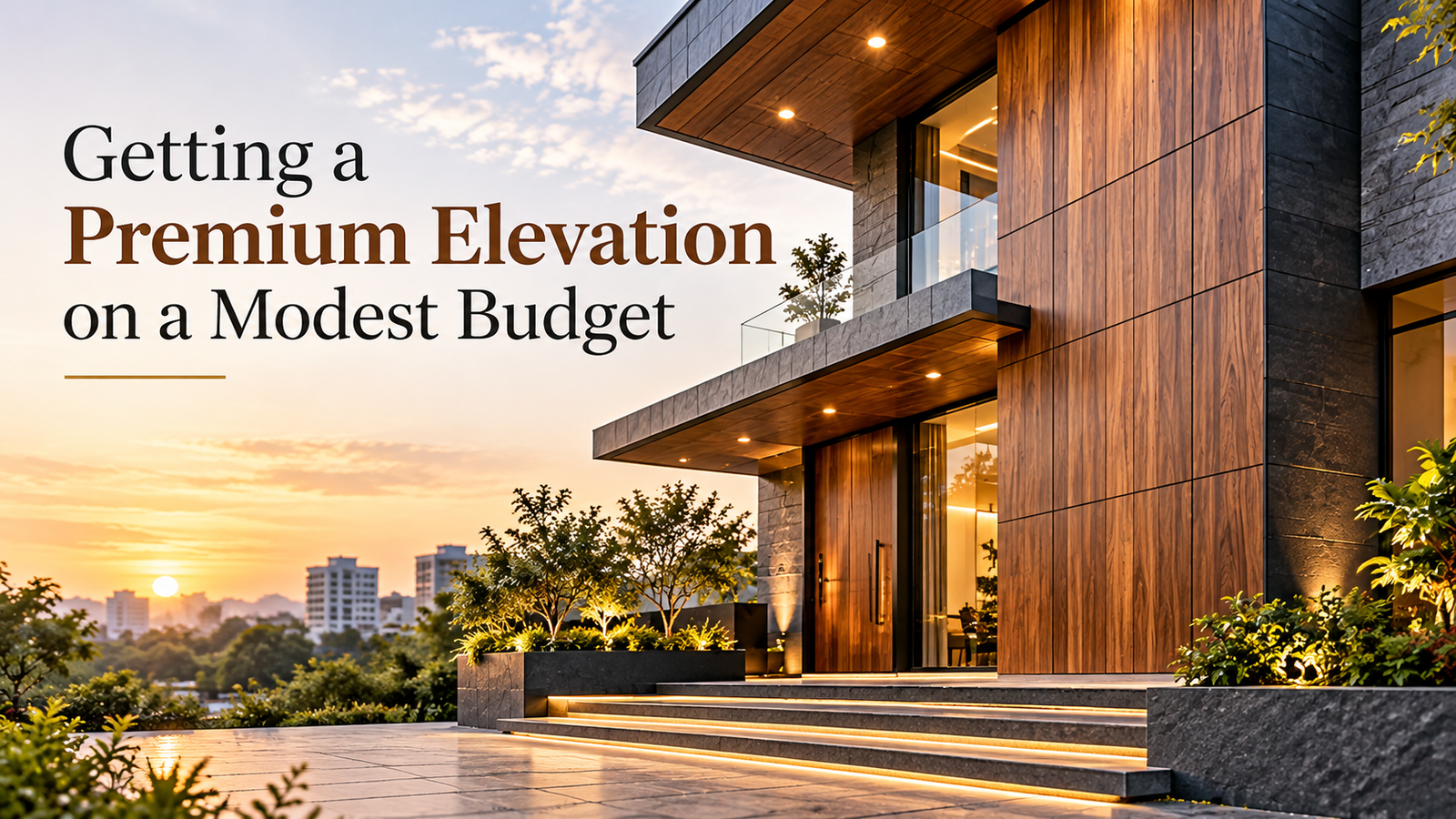
The most common budget mistake is spreading the money evenly across the whole facade. A thin layer of compromise everywhere looks worse than a small area done properly. Elevations that look expensive on a modest budget almost always concentrate the spend.
Where the Eye Actually Goes
Stand across the road from a house and notice what you look at. The entrance. The gate. Whatever volume projects forward or rises higher than the rest. Any element at eye level that you pass close to.
What you do not look at: the upper reaches of side walls, the area behind planting, the service elevation, the parapet.
A budget spent on the first group and saved on the second produces a house that reads as considered. The reverse produces a house that reads as evenly mediocre.
The Priority Order
1. The gate and compound wall
Disproportionate return. People see the gate from closer than anything else, and it occupies a large share of what is visible from the road. It is also a relatively small area, which makes a premium finish affordable here.
2. The entrance volume
The wall around and above the main door. This is where people stand, where guests are received, and where photographs get taken. Cladding this one volume changes the impression of the whole house.
3. The projecting or tallest element
Staircase tower, projecting balcony, double-height section. These already catch the eye for structural reasons; finishing them differently makes that deliberate.
4. Everything else
Good quality paint in a shade that works with the clad areas.
Combinations That Work on a Budget
Wood-finish cladding on the entrance, neutral grey paint elsewhere. The most reliable combination available and almost impossible to get wrong.
Clad gate and compound wall, painted house. Counter-intuitive and effective, especially on small plots where the boundary is a large share of the view.
One full-height vertical band running from plinth to parapet, paint either side. Uses little material and adds height.
Real Savings That Do Not Show
- Skip the rear and service elevations entirely. Nobody sees them.
- Keep the panel layout simple. Diagonal and curved arrangements increase both wastage and labour significantly.
- Do not over-specify thickness. Many residential facades are quoted thicker than they structurally need.
- Order in one consignment. Reduces transport cost and avoids shade mismatch between batches.
- Use solid colours where the design allows. Often cheaper than complex wood or stone decors.
Savings That Cost More Later
These are the ones worth refusing.
Cutting the framework specification. The single most expensive saving available. The frame sits in a damp cavity for twenty years; when it corrodes, the whole facade comes off to replace it. If the budget is tight, reduce the clad area instead.
Buying interior-grade material for outdoor use. It costs substantially less and looks identical on delivery day. It fades and fails within a couple of summers.
Skipping the expansion gaps and edge sealing. Saves nothing meaningful and causes bowing and water ingress.
Buying just enough with no wastage allowance. You will run short, and the top-up batch may not match.
A Workable Approach
This is the sequence we suggest to UVCLAD customers working to a fixed number, and it reliably produces a better-looking result than the reverse.
Decide the total you can spend. Take the framework and installation cost out first, properly specified. Whatever is left determines how much area you can clad — not the other way round.
Then clad that area starting from the top of the priority list and stop when the budget stops. A smaller area finished properly always beats a larger one finished thinly.
Frequently Asked Questions
How do I make a small elevation budget look expensive?
Concentrate it. Clad the gate and entrance volume properly and paint the rest, rather than spreading a thin treatment everywhere.
What is the worst place to cut cost?
The framework. It fails first and replacing it means removing the entire facade.
Can I clad only part of my house?
Yes, and it usually looks better than cladding everything. Most well-judged Indian elevations are built this way.
Should I reduce the clad area or the material grade?
Reduce the area. Grade and framework are where failures come from.
Tell us your budget and send an elevation photo — we will suggest where to spend it for the biggest visible difference.