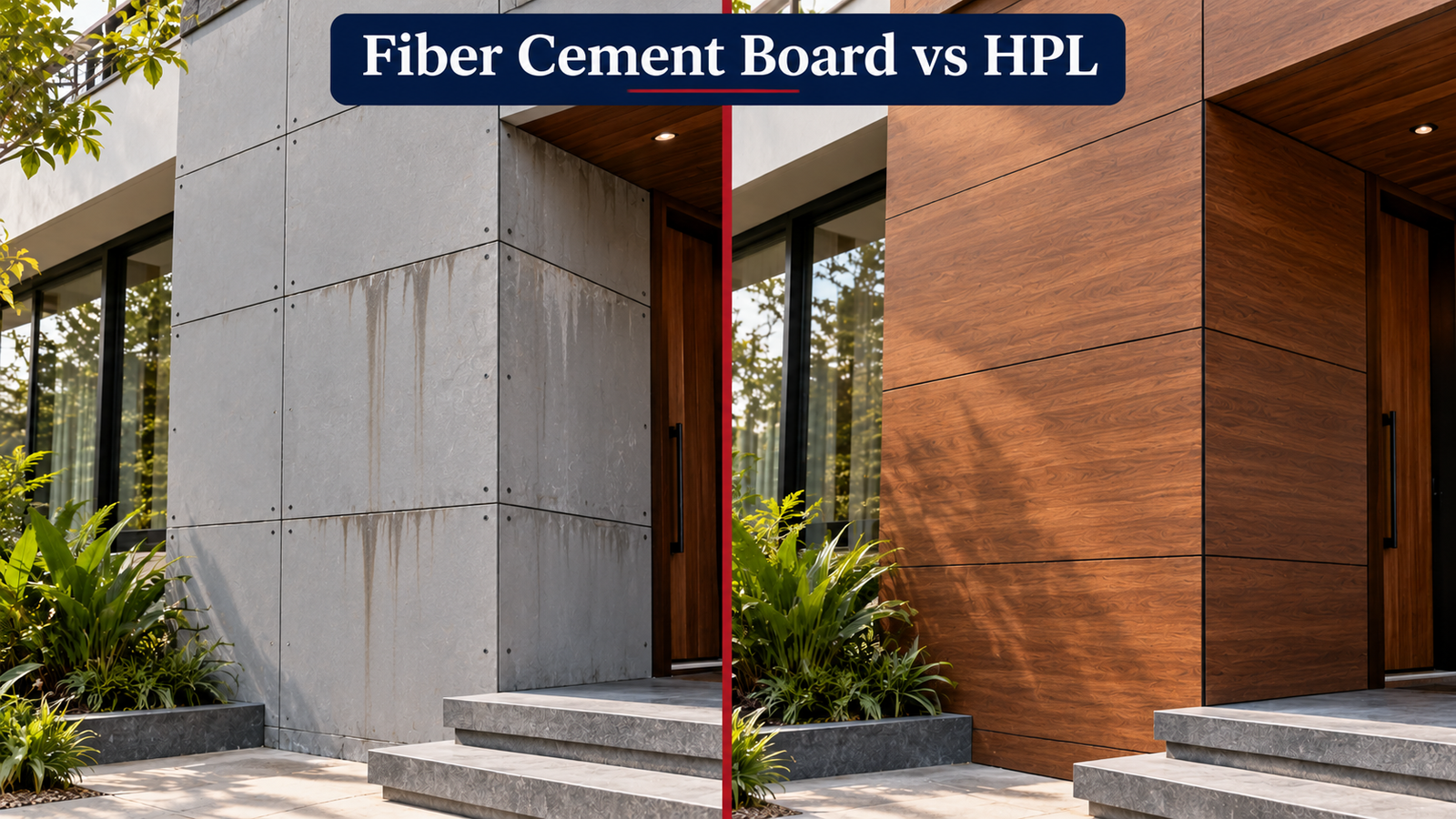
Fiber cement board and HPL both promise a modern, low-fuss exterior. On a showroom sample they can look surprisingly similar. The real difference shows up five monsoons later, and that's what this guide is about.
If you're planning a new elevation or upgrading an old one, you've probably been offered two options: cement board cladding, because it's affordable and fire-safe, and HPL, because it looks premium and needs no painting. Both are good materials. They just solve different problems.
Below, we compare fiber cement board for exterior walls with exterior HPL on the things that matter after installation day: water, sun, finish, upkeep and long-term cost. We'll also be clear about where fiber cement is the better pick.
For homes where looks and low maintenance matter most, exterior HPL is usually the better choice. It comes with a ready decorative finish, absorbs almost no water and never needs repainting. Fiber cement board makes more sense when the lowest upfront cost or a strict non-combustible fire rating is the priority, and you're happy to paint and maintain it.
What Is Fiber Cement Board?
Fiber cement board is a flat sheet made from cement, fine sand and cellulose (wood pulp) fibres. The fibres work like the steel in reinforced concrete. They hold the cement together so the sheet can bend slightly instead of snapping. Most boards are cured under high-pressure steam, which makes them hard and stable.
For cladding, these boards are usually 6 to 12 mm thick. They're screwed onto a metal or timber frame, and the joints are sealed. Most come plain grey and need to be primed and painted on site, though some premium boards are sold pre-coated in a few basic colours.
What Is Exterior HPL?
HPL stands for High Pressure Laminate. It's made by stacking layers of resin-soaked kraft paper with a decorative print on top. The stack is pressed under intense heat and pressure until it fuses into one dense, solid board. Exterior-grade HPL adds a UV-protective top coat so the colour doesn't fade in strong sun. You can read more about how this layer works in our guide on UV coating on HPL sheets.
The key point: with HPL, the finish is part of the sheet. There's nothing to paint, and the design runs the full width of every panel. UVCLAD exterior HPL comes in four series: Wooden, Marble, Stone and Solid Colours.
Fiber Cement Board vs HPL: Side-by-Side
| Factor | Fiber Cement Board | UVCLAD Exterior HPL |
|---|---|---|
| Finish | Plain grey; painted on site | Ready decorative finish from the factory |
| Design range | Paint colours; limited textures | Wood, marble, stone and solid shades |
| Water absorption | Absorbs moisture; edges must be sealed | Near zero; dense, closed surface |
| Repainting | Every few years outdoors | Never needed |
| Impact and edges | Brittle edges can chip or crack | Tough and slightly flexible |
| Fire behaviour | Non-combustible | Fire-resistant grades available |
| Upfront cost | Lower | Higher |
| Long-term cost | Adds repainting and repairs | Close to zero upkeep |
| Warranty | Varies by brand; paint not covered | 15 years with UVCLAD |
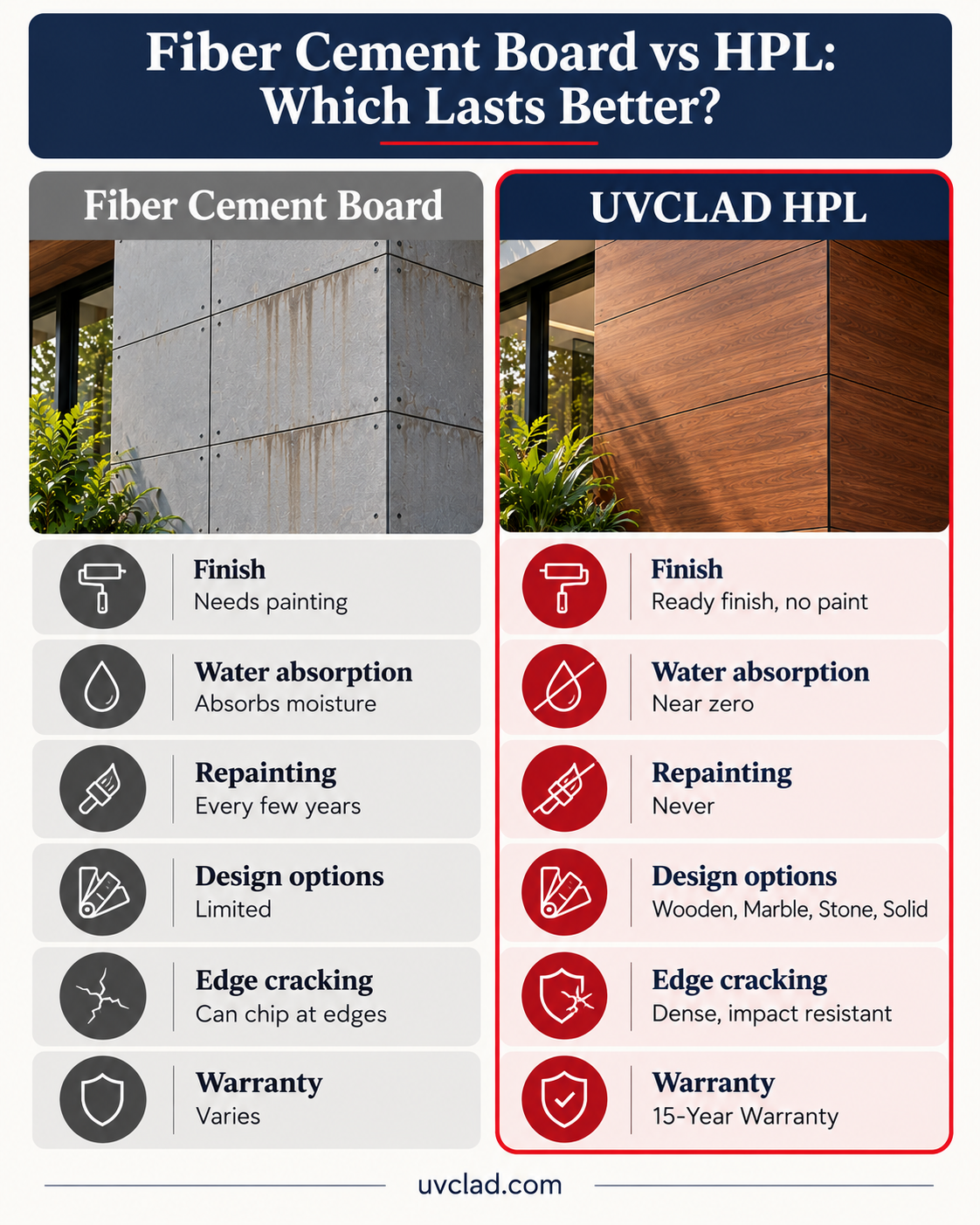
Where Fiber Cement Board Falls Short Outdoors
It drinks water
Cement is porous, and so is cellulose fibre. If the paint layer cracks or a cut edge is left unsealed, the board slowly takes in water. In a long Indian monsoon, that leads to swelling at the edges, dark damp patches and peeling paint. Once moisture gets in, it also weakens the board around the screws.
The finish is only as good as the paint
Fiber cement doesn't have a finish of its own. What you see is paint, and outdoor paint fades, chalks and cracks under strong sun. So a cement board wall needs a fresh coat every few years to keep looking new. That means scaffolding, labour and time, again and again. We've worked out what this adds up to in our paint vs HPL cost comparison.
Edges and corners are fragile
Fiber cement is hard but brittle. Over-tightened screws, a knock from a ladder, or drilling too close to the edge can crack a corner. Cutting it on site also creates fine dust that needs masks and dust control.
Why HPL Holds Up Better
Water stays outside. HPL's resin-pressed core is dense, so rain beads up and runs off instead of soaking in. There's no paint film to crack and let water through. Our guide on whether HPL cladding is waterproof explains this in detail.
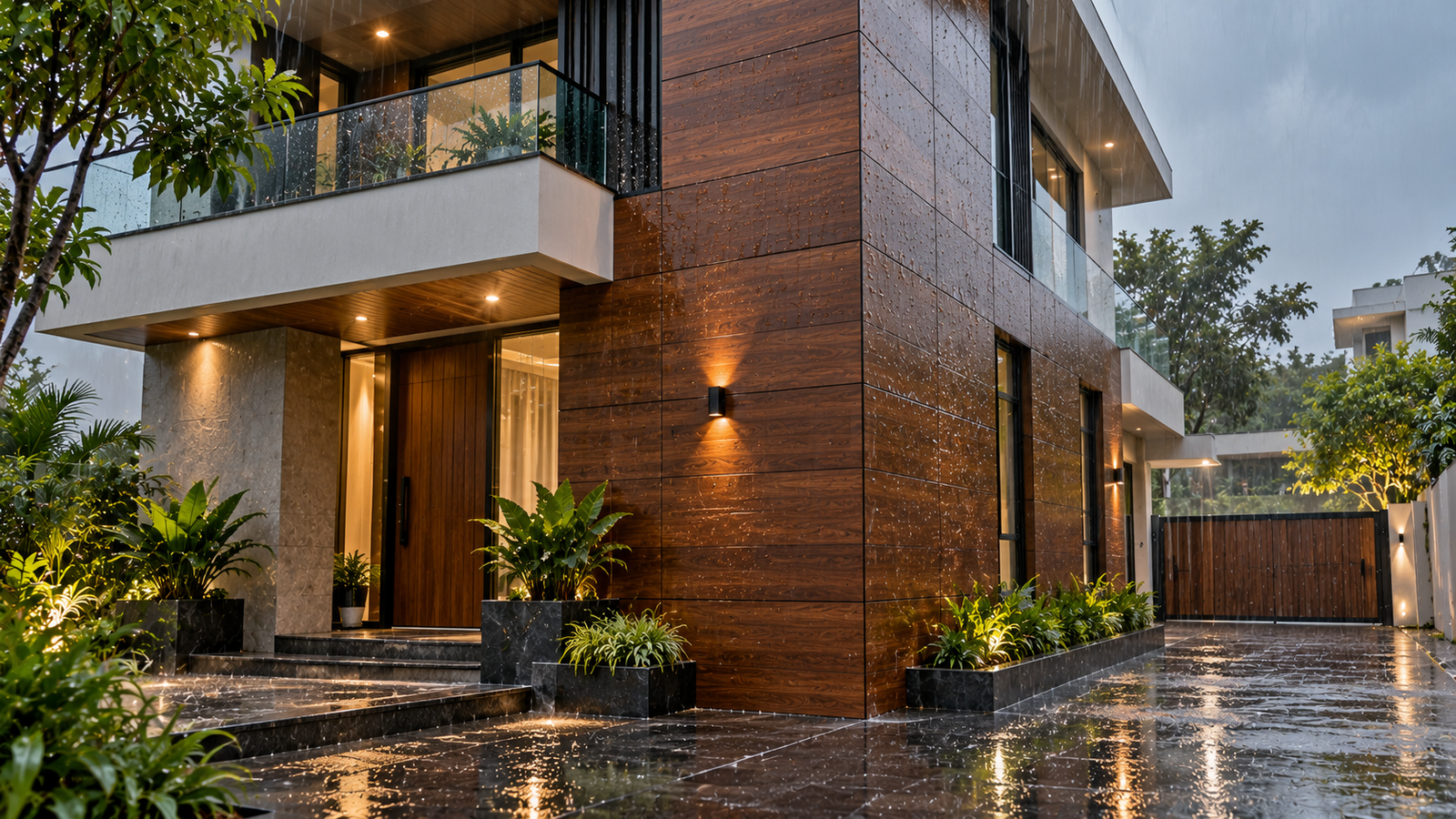
The finish is permanent. The wood, marble or stone design is pressed into the sheet and sealed under a UV-protective top layer. It won't peel, chalk or need a touch-up.
It handles daily knocks. HPL is tough and has a little flex, so it absorbs impact better at the corners and around fixings.
It lets the wall breathe. HPL is fixed on an aluminium frame with an air gap behind it. That gap lets moisture escape and keeps some heat off your wall. See how the framework and substructure are built.
When Fiber Cement Board Is the Right Call
Fiber cement does have real strengths. It's non-combustible, which matters for some commercial buildings and high-rise projects where codes ask for that rating. It also has a lower material cost, so it suits budget-driven work like site offices, service blocks, boundary sheds or back walls that nobody sees.
Choose fiber cement if…
- Lowest upfront cost is the top priority
- The project needs a non-combustible board by code
- The wall is functional, not a design feature
- You're fine repainting every few years
Choose UVCLAD HPL if…
- You want a premium wood, marble or stone look
- You don't want to repaint or maintain the wall
- Your wall faces heavy rain or strong sun
- You want a 15-year warranty behind your facade
How to Decide in 4 Steps
- Define the wall's job. Is it the face of your home or a hidden service wall? Feature walls need a finish that lasts.
- Check the weather exposure. West and south walls get the most sun, and open walls take the most rain. These need the most durable material.
- Count the 10-year cost, not the day-one cost. Add repainting and repairs to cement board's price before comparing.
- Look at the warranty. Ask what's covered and for how long. Our 15-year warranty guide explains what to look for.
Frequently Asked Questions
Is HPL better than fiber cement board for exterior walls?
For most homes, yes. HPL comes with a ready decorative finish, absorbs almost no water and never needs repainting. Fiber cement board is cheaper upfront and non-combustible, but it needs painting and regular maintenance outdoors.
Does fiber cement board absorb water?
Yes. Fiber cement is porous, so it can take in moisture through cut edges or cracks in the paint. That's why the edges must be sealed and the paint kept in good condition. Exterior HPL has a dense, closed surface that absorbs almost no water.
Does cement board cladding need painting?
Most fiber cement boards are supplied plain and must be primed and painted after installation. Outdoors, that paint usually needs redoing every few years. HPL has a permanent factory finish and never needs paint.
Which is cheaper, fiber cement board or HPL?
Fiber cement board has a lower material cost. Once you add primer, paint, labour and repainting over 10 years, the gap shrinks a lot, and HPL's near-zero maintenance often makes it the better long-term value.
Is HPL fire-resistant?
Exterior HPL is available in fire-resistant grades. Fiber cement is fully non-combustible, so for projects where building codes demand a non-combustible board, check the required fire rating before choosing. Read more in our guide on fire-resistant exterior cladding.
Ready for a facade that never needs paint?
Explore UVCLAD exterior HPL in Wooden, Marble, Stone and Solid finishes, backed by a 15-year warranty.
Shop HPL Sheets Get a Free Quote