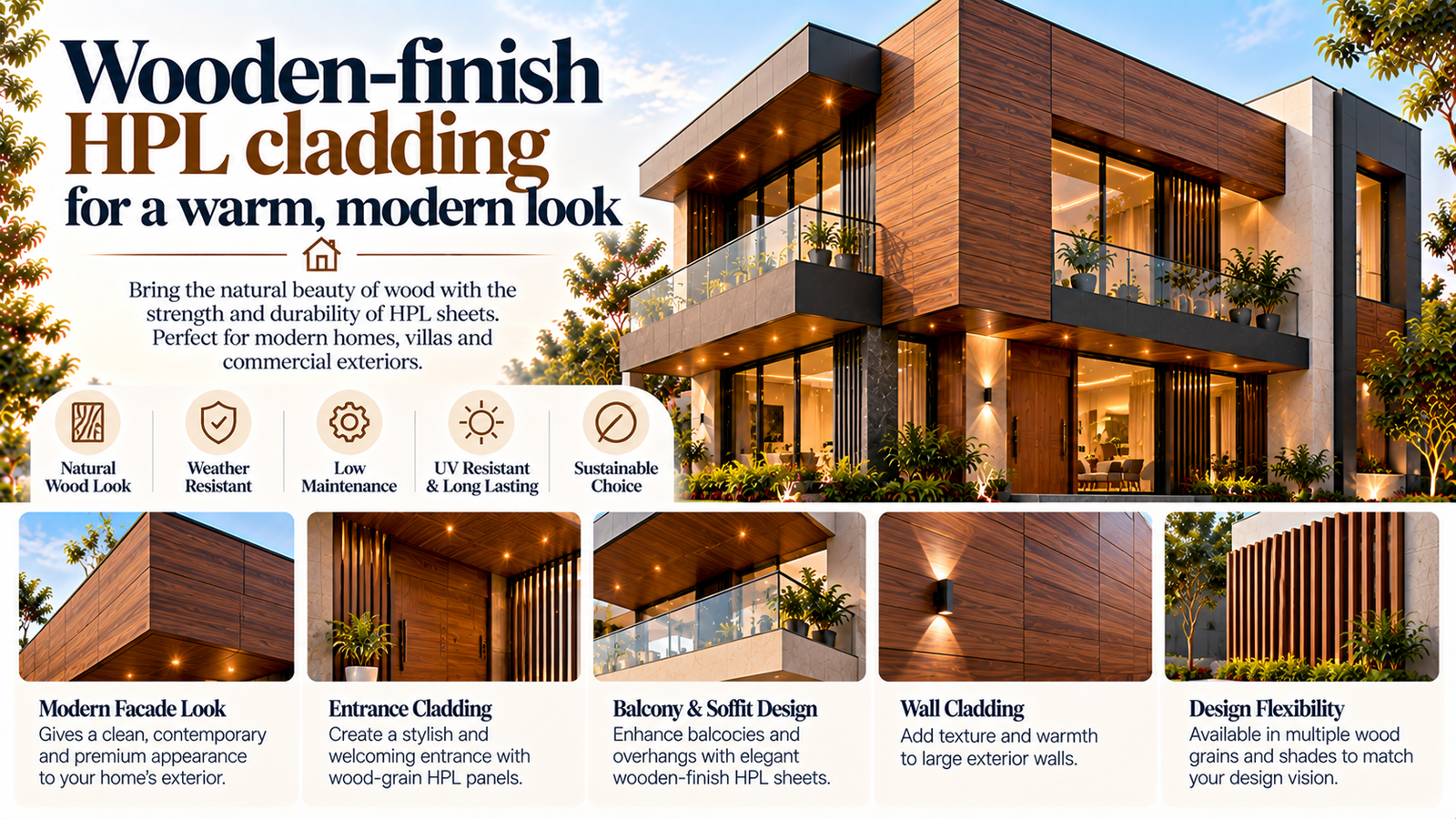
There’s a reason wood-finish facades keep showing up in architecture magazines and on Pinterest boards for Indian homes — warm timber tones do something a flat painted wall just can’t. They add texture, they photograph well in evening light, and they soften what would otherwise be a hard, boxy elevation. The problem has always been that real wood outdoors is a maintenance commitment most people underestimate until they’re three years in.
Why real timber cladding is a harder sell than it looks
Exterior timber needs regular sealing or oiling, is vulnerable to termites in most Indian climates, warps with humidity swings, and eventually needs sections replaced. It looks stunning on day one and in the architect’s render. Five years in, without a serious maintenance budget, it often looks patchy and tired instead.
What a wood-finish HPL panel actually gives you
The visual grain, tone and texture of timber, printed and pressed into the decorative layer of a compact laminate panel that behaves nothing like real wood once it’s up. No termite risk. No oiling schedule. No warping with the monsoon. The panel is fixed dry, on a frame, so there’s no wet timber joinery to maintain either.
Where wood-finish tones work best
A few patterns show up consistently in the projects we’ve seen:
Full wood-finish facades work well on homes with a lot of glass — large windows or a glass-heavy entrance — because the warm tone balances what would otherwise be a cold, all-glass-and-concrete look. Partial wood-finish bands, run horizontally across a section of the elevation or wrapped around a balcony or entrance porch, tend to work on more conventional box-shaped homes where a full timber look would feel heavy. And wood-finish paired with a solid dark base colour — the ground floor in solid charcoal or graphite, the upper floor or a feature band in wood tone — is one of the more requested combinations right now, especially for independent villas.
Choosing between light and dark wood tones
Lighter, honey-toned finishes tend to suit homes in warmer, sunnier settings and show detail well in strong daylight. Darker walnut and teak tones photograph beautifully but absorb more heat on a west-facing wall in peak summer, which is worth factoring in if that’s the elevation getting clad. Neither is objectively better — it comes down to which wall you’re doing and what look you’re going for.
Pairing wood-finish with other UVCLAD series
Wood-finish rarely works best alone across an entire elevation. The strongest results tend to combine it with the stone series at a plinth or base level for visual weight, or with a solid neutral tone to break up a large wood-finish surface so it doesn’t read as flat repetition. If you’re planning a mixed-finish facade, it’s worth working out the proportions — roughly how much wood versus how much of the second material — before ordering, rather than adjusting after panels arrive.
FAQ
Does wood-finish HPL fade differently than solid colours?
Wood tones are generally in the earthy/brown family, which tends to hold colour well under UV exposure compared to reds or deep blues — see our post on UV resistance for the full explanation.
Can wood-finish panels be combined on the same wall as a different material entirely, like exposed brick?
Yes, this is a common combination — wood-finish HPL panels alongside exposed brick or stone masonry sections is a look a lot of architects are specifying right now.
How many wood-finish variants does UVCLAD offer?
Several tonal variants across light, medium and dark ranges. Order a physical sample rather than deciding from a screen — wood-finish tones especially look different under real daylight than on a monitor.
Order a wooden-finish sample and see the grain and tone in person before committing to a full elevation.