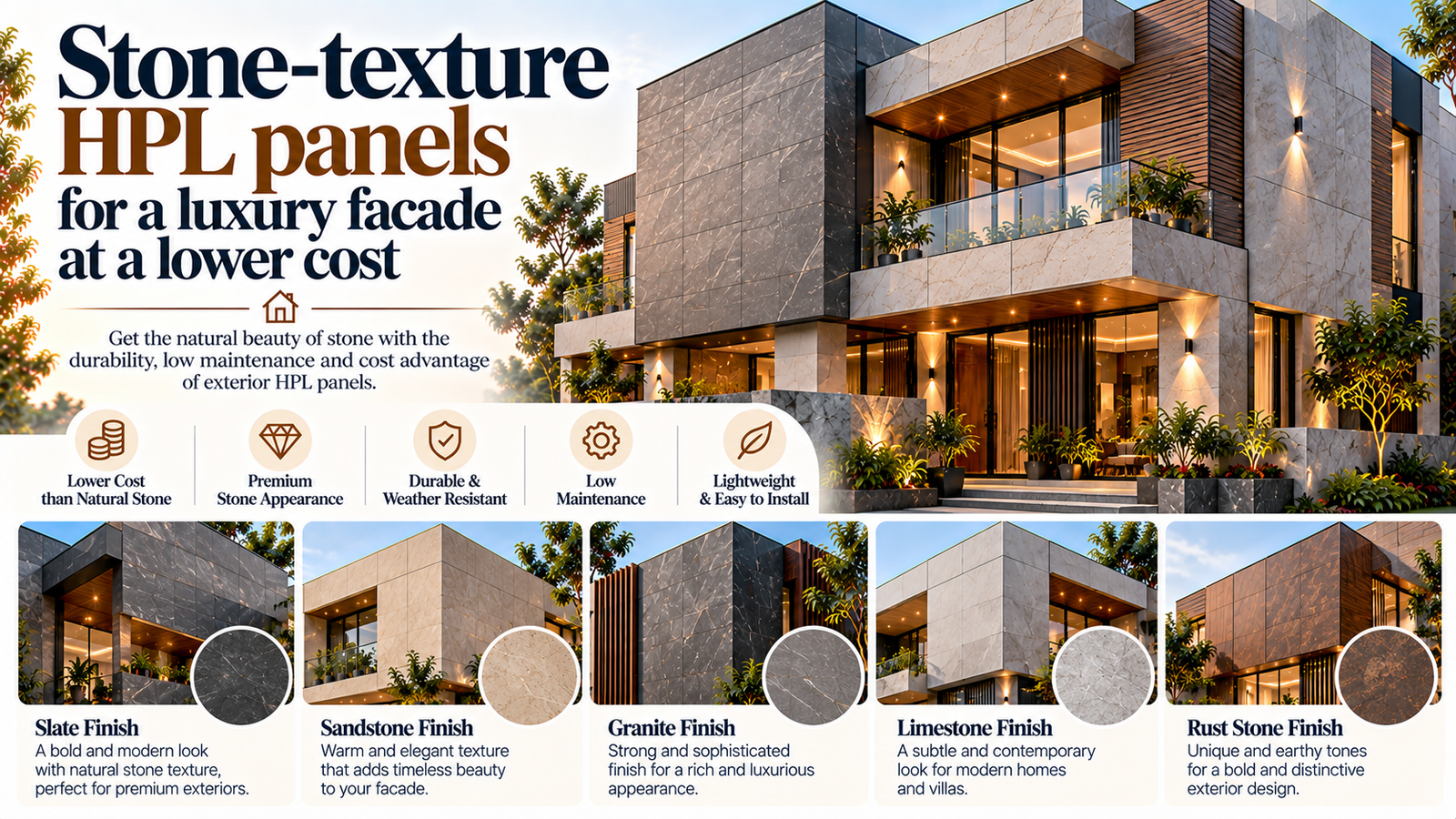
Natural stone cladding has always signalled a certain kind of home — the kind with a driveway, a gate, and a facade that photographs well for a wedding invitation. It’s also one of the more expensive and structurally demanding finishes available, which is exactly the gap stone-texture HPL panels are built to close.
Why real stone cladding is expensive beyond the material cost
Stone is heavy. That means the wall structure behind it needs to be engineered to carry the load, which isn’t always accounted for in an existing building’s design, especially on a renovation rather than new construction. Beyond the stone itself, you’re paying for a mason skilled in stone fixing, longer installation time, and in many cases a stone that’s been sourced and cut specifically for the project. The total cost adds up fast, and it adds up before you’ve even accounted for sealing the stone against staining.
What stone-texture HPL panels solve
The panel is lightweight compared to actual stone — fixed the same way any HPL panel is fixed, on a standard frame system, with no structural load consideration needed beyond what any cladding requires. The texture and tonal variation of natural stone is captured in the decorative layer, so from a normal viewing distance the visual read is convincingly close to the real material.
Where the visual difference actually shows
Up close, at arm’s length, a trained eye can usually tell the difference between real stone’s irregular surface and a printed texture. From the street, from a car, from across a driveway — which is how a facade is actually experienced most of the time — the difference is far less noticeable than the cost difference would suggest.
Design combinations that work
Stone-texture is most often used at the base or plinth level of a facade, running up to window-sill height, with a different finish above — wood or a solid tone — for the rest of the elevation. This mimics a classic proportion seen in a lot of premium architecture, where a heavier-looking material anchors the bottom of a building visually and a lighter material carries the upper floors.
It also works well around an entrance porch or a feature wall specifically, rather than across an entire facade, if the goal is a focal point rather than a full stone-look house.
What to check before ordering
Ask to see the panel under both bright daylight and shaded light — stone textures can read differently depending on light angle, more so than a flat solid colour would. And if you’re doing a partial application (base only, or an entrance feature), get the proportions worked out against your actual elevation drawing rather than guessing, since stone-texture panels tend to look most convincing when the transition line to the other finish lands at a sensible architectural point — a sill line, a change in wall plane — rather than an arbitrary height.
FAQ
Is stone-texture HPL heavier than the wood or solid series?
No, all UVCLAD HPL panels are the same base material and weight regardless of the decorative finish. The visual texture doesn’t add weight.
Can stone-texture panels be used on a boundary wall or gate pillar, not just the house itself?
Yes, this is a common request, particularly for gate pillars and compound walls, where a stone look adds presence without the structural considerations real stone would need there too.
How many stone finish variants are available?
Multiple tonal ranges, from lighter sandstone-like tones to darker granite-like finishes. See the stone series catalogue for the current range.
See the stone series catalogue and ask for a physical sample panel before finalising the design.