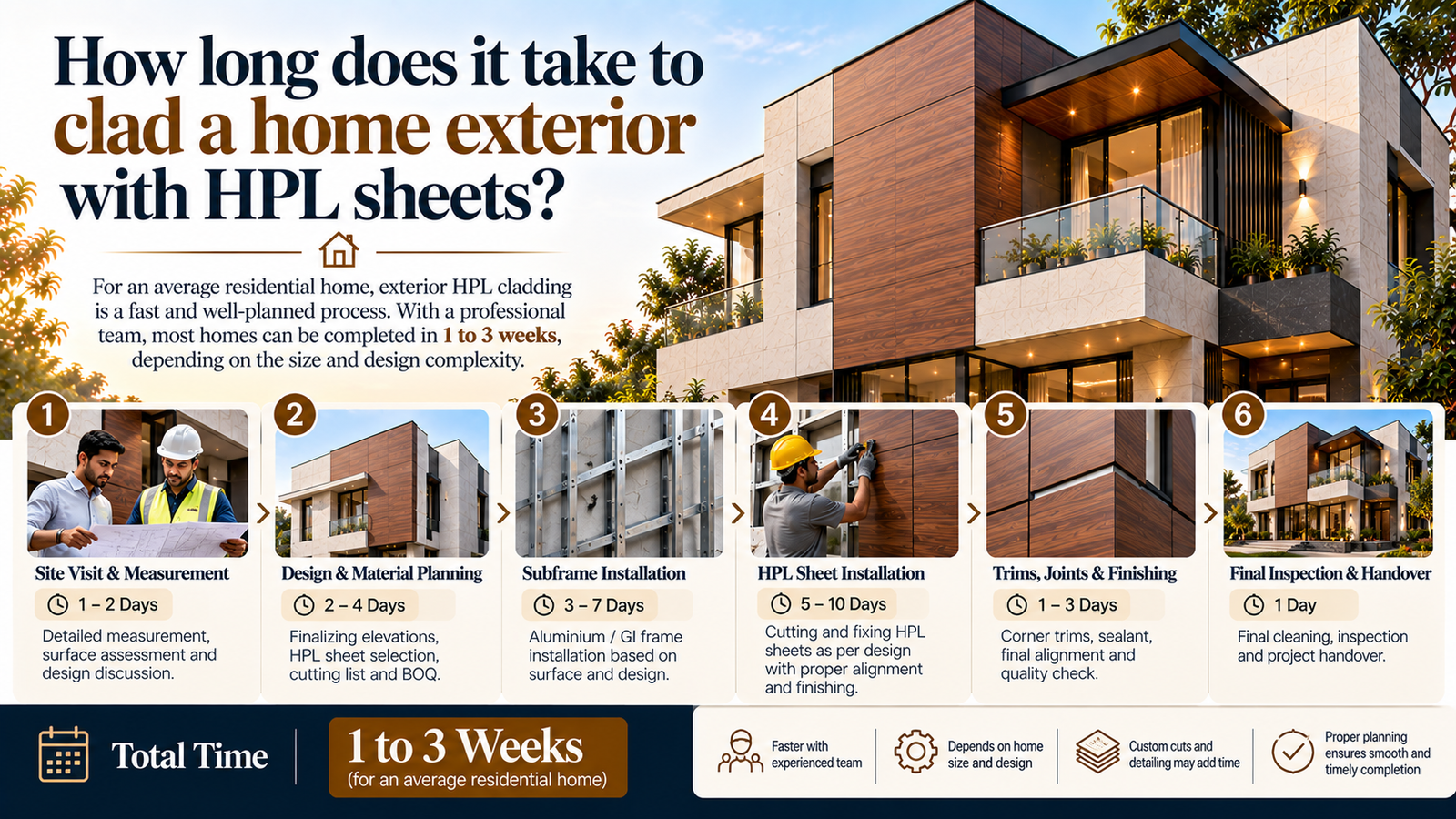
If you’re planning renovation around a specific date — a festival, a family event, a griha pravesh — the timeline question matters more than almost anything else in the decision. Here’s a realistic breakdown, not an optimistic sales estimate.
Measurement to order confirmation: a few days
Site measurement, finish selection if not already finalised, and formal quote confirmation typically takes a few days from first contact, assuming reasonably quick decisions on finish and design on the homeowner’s side. This can stretch out considerably if finish decisions are still being debated — worth having a shortlist ready before this stage starts.
Production and dispatch: roughly one to two weeks
Once an order is confirmed, panels are cut and prepared based on the exact site measurements. This isn’t off-the-shelf stock being shipped same-day — it’s measurement-specific, which takes some lead time but ensures an accurate fit rather than generic sizing.
On-site installation: typically three to five days for an average home
For a standard independent home doing a full or substantial partial facade, on-site work — substructure, panel fixing, joint detailing, clean-up — usually runs three to five working days, weather permitting. Larger or more architecturally complex facades can run longer; a small entrance feature or partial application can be considerably faster.
Total timeline, realistically
From first site visit to a finished facade, most residential projects complete in three to four weeks. This is considerably faster than most homeowners assume, largely because there’s no drying or curing time the way there is with wet-applied finishes.
What actually causes delays
Slow decision-making on finish selection is the most common one, honestly — indecision between two or three options can stretch the pre-production phase by days or weeks with no fault on the installation side. Beyond that, unusually complex architectural detailing, difficult site access, or peak festive-season demand (when everyone wants the same installation window) can extend the timeline. This is exactly why booking early relative to a target date, rather than right before it, matters.
Timing it around a festival or event date
If you have a specific date in mind — Diwali, a griha pravesh, a family wedding — work backward from that date with at least four to five weeks of buffer, ideally more during peak festive demand when scheduling gets tighter across the board. See our post on the best time of year to plan renovation for more on how that seasonal timing works.
FAQ
Does the timeline change for a multi-storey or commercial building?
Yes, larger and taller projects scale up proportionally in both production and on-site time — get a project-specific timeline rather than assuming the residential average applies.
Can installation happen during monsoon season?
It’s technically possible but not ideal — heavy, sustained rain slows outdoor fixing work and isn’t the best working condition for sealant application. Late monsoon or post-monsoon timing tends to go more smoothly.
Is there a way to speed up the process if I’m on a tight deadline?
Fast decision-making on finish selection helps most, since that’s usually where time gets lost before production even starts. Reach out early and we’ll be upfront about whether a specific date is realistic.
Check installation slots before Diwali — festive season scheduling fills up, so earlier booking protects your preferred date.