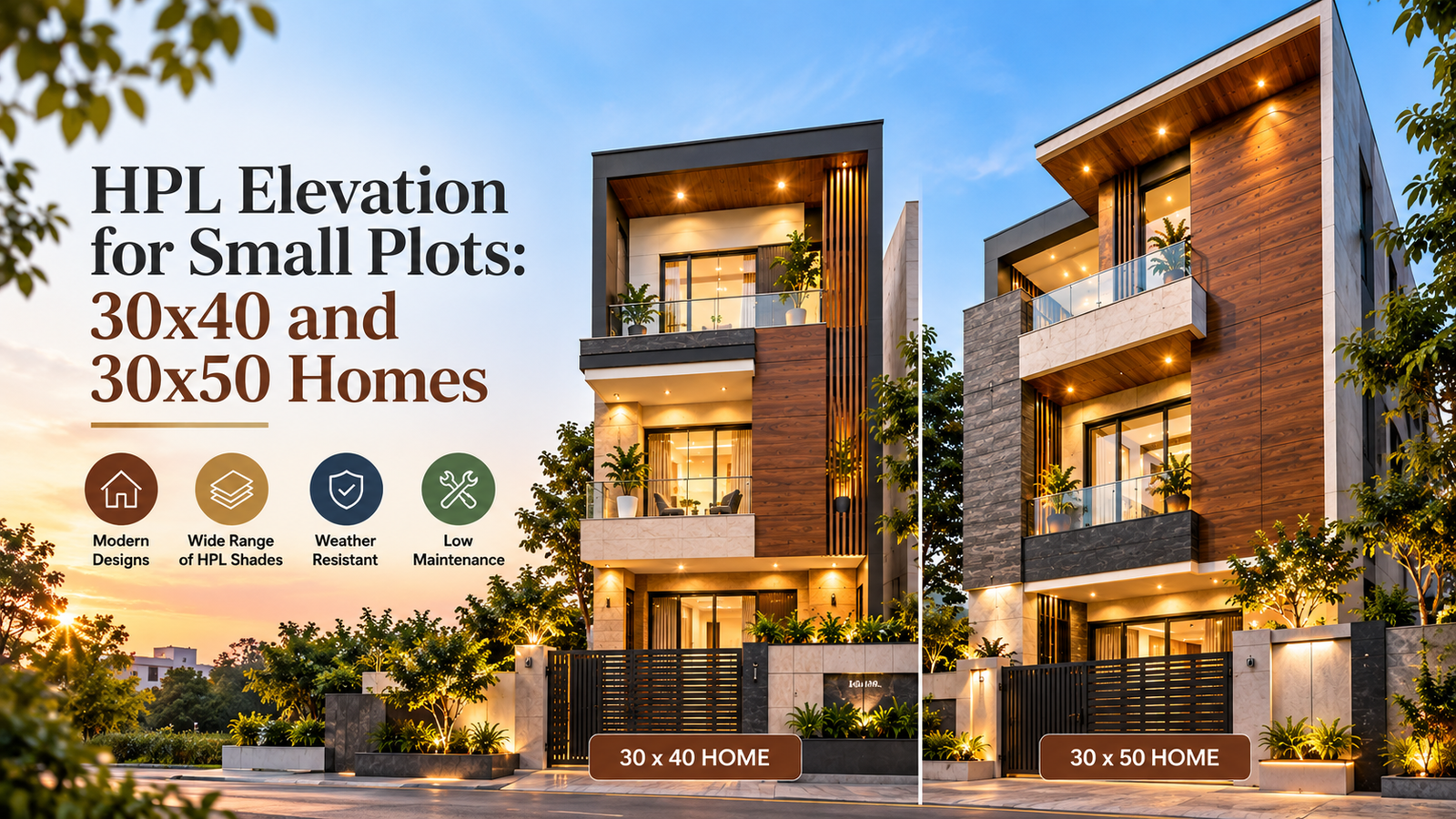
On a 30×40 or 30×50 plot you typically have 25 to 30 feet of visible frontage, which is roughly a third of what a large villa works with. That is not a limitation so much as a constraint that rewards restraint — small elevations look worse when you add more, not better.
The Mistake Most Small Elevations Make
Trying to fit everything in. Three different materials, a feature band, a contrasting parapet, decorative brackets and a nameplate panel, all across 28 feet of wall.
At that width the eye cannot separate the elements. Everything reads at once and the result looks busy rather than designed. The elevations that look expensive on small plots are almost always the simplest ones.
What Works
Vertical emphasis
Narrow frontages benefit from anything that draws the eye upward. Vertical slat panels, a full-height cladding band running from the plinth to the parapet, or cladding the staircase volume floor to roof — all make the house read taller than it is.
Horizontal banding does the opposite. On a wide bungalow it emphasises breadth, which is good. On a 28-foot frontage it makes the house look squatter.
One feature element, not three
Pick the volume that matters — usually the entrance, the staircase tower, or the projecting balcony — and clad that. Leave the rest in textured paint.
This concentrates the budget where it is visible and gives the eye one thing to land on. It is also considerably cheaper than cladding the whole facade, which matters more on a small plot where the whole house budget is tighter.
Two materials maximum
One dominant, one accent. Wood-finish panel against a neutral grey paint is the most reliable combination and almost impossible to get wrong.
Let the gate and compound wall do work
On a small plot the gate occupies a large share of what people actually see from the road. Cladding the gate and the compound wall in the same finish as the house feature makes the whole frontage read as one considered thing, and it is relatively little material.
Realistic Budget
A typical small-plot frontage has somewhere between 400 and 700 square feet of visible elevation including the compound wall. Cladding all of it is a real expense.
Cladding a single feature volume — say 150 to 250 square feet — plus the gate, lands in a far more manageable range and produces most of the visual effect. This is the approach we would suggest to anyone on a constrained budget rather than stretching to cover everything thinly.
Shade Choices for Narrow Frontages
Most UVCLAD orders from small-plot homeowners are for a single feature volume plus the gate rather than a full facade, which is usually the right call.
Mid-tone woods work on almost every small elevation. They add warmth without visual weight, and they hide dust, which matters more at street level on a tight plot where the house sits close to the road.
Very dark shades can overwhelm a narrow frontage and make it feel heavy. If you want dark, use it as a thin vertical band rather than a broad surface.
Very light shades show dust and splash from the road quickly when the wall is only a few feet from traffic.
Frequently Asked Questions
How much elevation area does a 30×40 house have?
Typically 400 to 700 square feet of visible frontage including the compound wall, depending on the number of floors.
Should I clad the whole front of a small house?
Usually not. Cladding one feature volume plus the gate gives most of the visual effect at a fraction of the cost, and looks less busy.
Do vertical or horizontal panels suit narrow plots better?
Vertical. It draws the eye upward and makes a narrow frontage read taller. Horizontal banding emphasises width, which works against you here.
Which shade suits a small frontage?
Mid-tone wood finishes. They add warmth without the visual heaviness of dark shades, and they handle street-level dust better than light ones.
Send us your frontage dimensions on WhatsApp and we will suggest which volume to clad and roughly what it will take.