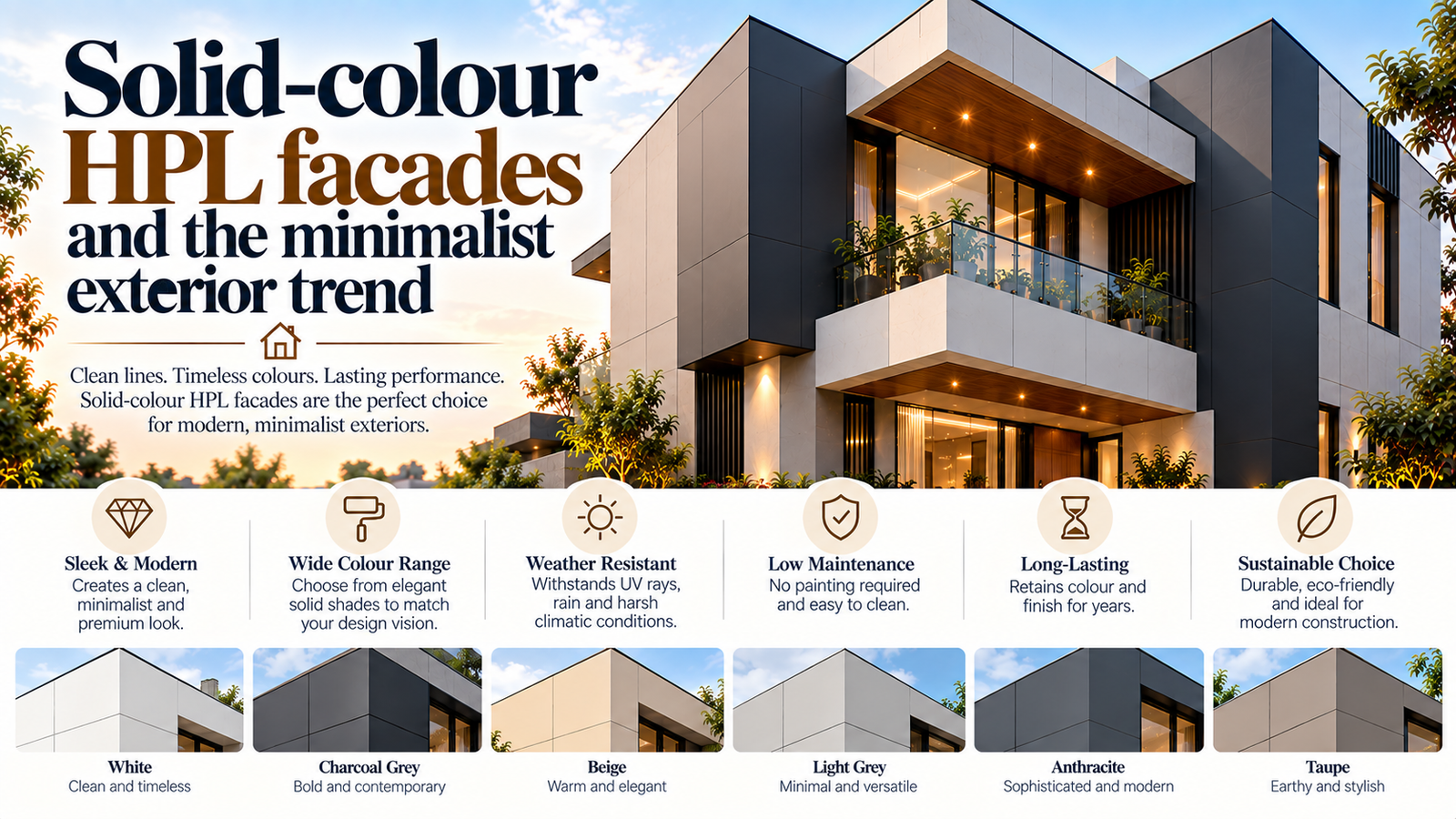
Not every homeowner wants their house to announce itself with texture and pattern. A growing number are going the other way entirely — a single, flat solid tone across the whole facade, no wood grain, no stone print, nothing competing for attention. It’s a quieter kind of confidence, and it’s showing up more often in newer builds specifically.
What’s driving the shift
Part of it is architectural fashion cycling the way it always does — heavily textured, ornamented facades were the statement a decade ago, and a cleaner, more restrained look is what reads as current now. Part of it is practical: a solid tone is the easiest finish to plan against, since there’s no pattern repeat or grain direction to work around during installation, and it’s the easiest to visualise accurately before panels arrive, because what you see in the sample is exactly what the whole wall will look like.
Which solid tones are actually being chosen
Deep charcoal and graphite greys lead by a wide margin in what gets requested, followed by muted, almost dusty versions of green, blue and terracotta — nothing too saturated or bright. Pure white shows up less than people might expect; most homeowners going solid still want some depth and warmth to the tone rather than a stark, clinical white.
Where solid-colour facades work particularly well
Homes with strong architectural geometry — clean rectilinear volumes, a clear roofline, well-proportioned window openings — benefit most from a solid finish, because the tone lets the actual architecture do the visual work instead of competing with a busy texture. If a home’s design already has a lot going on structurally (multiple roof levels, varied window shapes, several material changes), a solid facade can actually simplify and calm the overall read.
The maintenance argument specifically for solid tones
One thing worth knowing: on a solid panel, any dust or watermarking is marginally more visible than on a textured wood or stone finish, simply because there’s no pattern to visually break it up. This isn’t a durability issue — it’s purely about visibility between washes. A twice-yearly wash keeps it looking clean regardless, but if the facade is near a busy road with more dust exposure, it’s worth knowing this upfront rather than being surprised by it later.
Combining solid tones instead of going single-colour
Solid doesn’t have to mean one colour for the whole house. A two-tone solid combination — a darker base with a lighter upper floor, or the reverse — is common and keeps the minimalist read while still giving the elevation some visual structure.
FAQ
Do solid colours fade differently than textured finishes?
Fade behaviour is primarily about the pigment used, not whether the finish is textured or solid — see our UV-resistance post for how that actually works across all UVCLAD finishes.
Is a solid-colour facade cheaper than a textured one?
Pricing is generally comparable across finishes within the same panel grade — the choice is a design decision more than a cost-saving one.
Which solid tones are currently most requested for UVCLAD projects?
Charcoal, graphite and muted deep green are the current front-runners, based on what’s actually being ordered rather than just browsed.
Browse the solid colour range and request a sample of the tones you’re considering before committing to the whole facade.