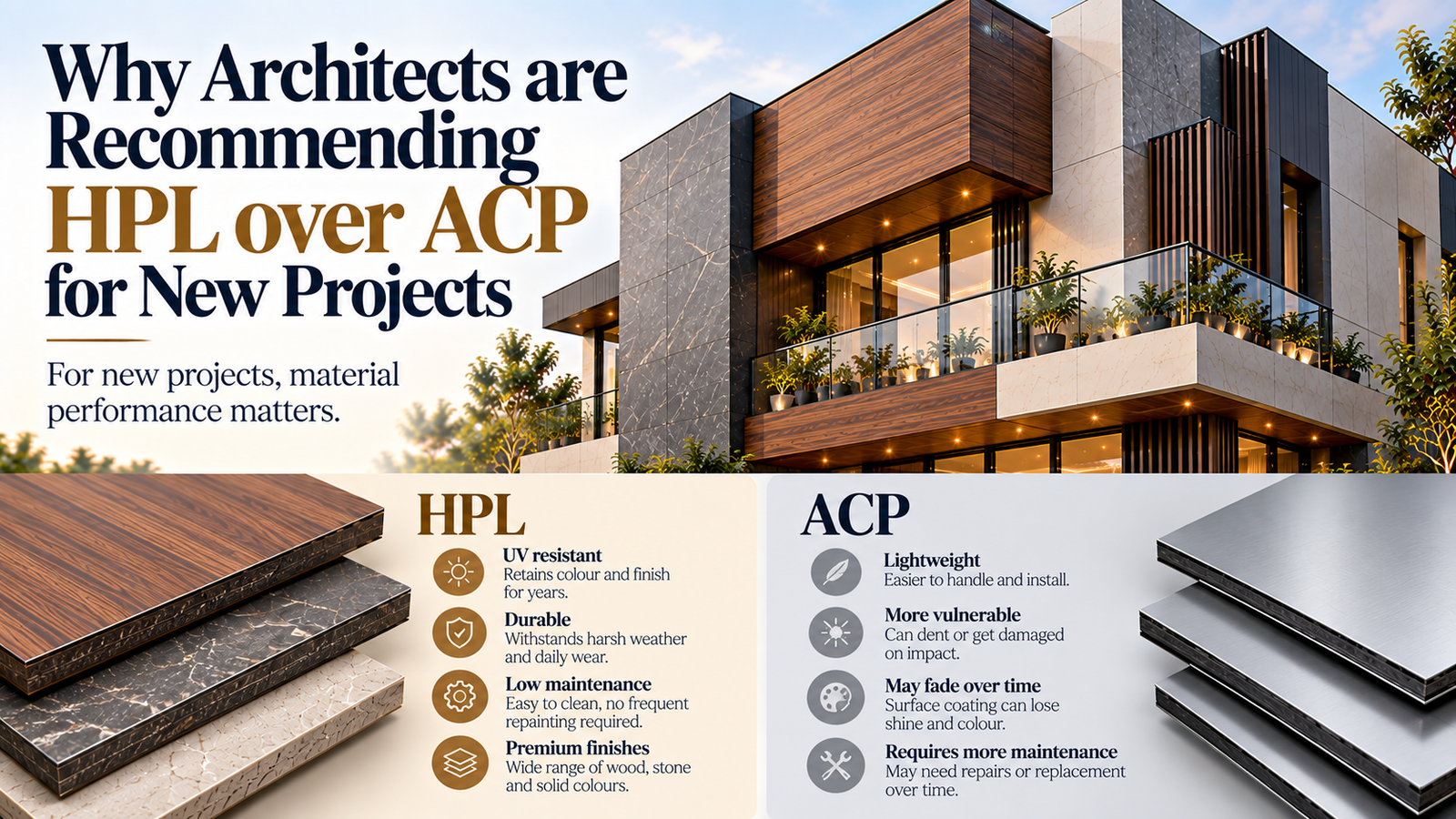
ACP was the default exterior cladding recommendation for years — cheap, fast to fabricate, available everywhere. That’s shifting. In conversations with architects working on both residential and commercial projects recently, the same handful of reasons keep coming up for why HPL is winning the specification more often now.
The fire-safety conversation changed, and it hasn’t changed back
This is the one that comes up first, unprompted, in almost every conversation. Several serious international building fires over the past decade were directly linked to combustible ACP cladding, which pushed regulatory scrutiny and client awareness both several notches higher. One architect we spoke with put it plainly: clients ask about fire rating now in a way they simply didn’t five years ago, and being able to answer that question cleanly with HPL, without needing to specify and justify an upgraded fire-retardant ACP grade, makes the specification conversation shorter and more comfortable.
Denting complaints were a recurring maintenance headache
A few architects mentioned fielding client complaints months or years after handover about dented ACP panels — a delivery cart, scaffolding from a neighbour’s construction, everyday wear that a thin aluminium skin just doesn’t handle well. It’s a small thing individually, but it’s the kind of callback that reflects badly on a specification choice, repeatedly, over the life of a project. HPL’s solid panel construction largely removes that specific complaint from the list.
Fewer surprises at handover
A recurring theme was consistency — HPL panels, being a solid, uniform material through their thickness, tend to have less batch-to-batch and panel-to-panel variation than some ACP products, which matters on a large facade where dozens or hundreds of panels need to read as a single cohesive surface.
The cost gap has narrowed
ACP is still generally cheaper per square foot upfront. But as fire-retardant ACP grades (the ones actually appropriate for taller or commercial buildings) have become more standard and expected, that upfront cost gap against HPL has narrowed considerably — several architects noted that once you’re comparing HPL against properly fire-rated ACP rather than the cheapest standard grade, the decision becomes much more about long-term performance than upfront price.
What this means if you’re specifying a project now
It’s worth pricing both materials on a like-for-like basis — HPL against fire-retardant, not standard, ACP — before deciding purely on upfront cost. And it’s worth asking any ACP supplier directly which core grade you’re being quoted, since that single detail changes the fire-safety picture significantly.
The Elevation Partner Program, for architects specifying UVCLAD
For architects and design consultants who specify UVCLAD on client projects, our Elevation Partner Program offers a partner incentive on closed projects, along with direct access to technical specification support, sample kits, and CAD detailing. See our post on becoming a UVCLAD partner for the full structure.
FAQ
Is HPL always the right recommendation over ACP, in every case?
Not automatically — for low-budget, low-risk applications like small interior signage, standard ACP may still be a reasonable and economical choice. The shift discussed here is specifically about exterior facade specification, particularly on taller or client-facing buildings.
Do you provide technical support directly to specifying architects?
Yes, including data sheets, fire test documentation, CAD details, and project-specific consultation for non-standard conditions.
How does the Elevation Partner Program incentive actually work?
It’s a percentage-based incentive on projects an architect or contractor refers that close as UVCLAD orders — full details are covered in our dedicated partner program post.
Join the Elevation Partner Program and get direct specification support for your next project.